1. Can Police Stop You Randomly in Taiwan?
Police officers in Taiwan do not have unlimited authority to stop and question anyone at any time. Whether a police stop is lawful depends on the location, circumstances, purpose of the stop, and whether the statutory requirements under the Police Authority Exercise Act are satisfied.
1.1 When Police May Verify Your Identity
Under Article 6, Paragraph 1 of the Police Authority Exercise Act, police may verify a person’s identity in public places or places they have lawfully entered when one of the statutory circumstances exists.
These circumstances include reasonable suspicion that the person has committed or intends to commit a crime; facts indicating that the person may know about a crime that has occurred or is about to occur; circumstances showing that identity verification is necessary to prevent concrete danger to life or bodily integrity; presence at a location associated with conspiracy, preparation, or commission of serious crimes; unauthorized presence in a restricted location; or passage through designated public places, roads, or checkpoints.
Article 6, Paragraph 1 of the Police Authority Exercise Act: Police may verify the identity of persons in public places or places lawfully entered when the statutory circumstances prescribed by law are present.
1.2 Does a Police Stop Require Reasonable Grounds?
Outside circumstances independently authorized by law, police generally cannot rely solely on intuition or a vague feeling that someone “looks suspicious” to justify intrusive police action.
For example, merely walking down the street, driving normally, or having a prior criminal record does not automatically authorize police to conduct an unlimited search.
A critical question in any dispute involving a police stop is therefore: What objective circumstances existed when the police exercised their authority? This distinction can later become important when determining whether the stop, inspection, subsequent search, and evidence obtained were lawful.
2. What Procedures Must Police Follow During a Stop?
Even where police have legal grounds to conduct a stop, the exercise of police authority remains subject to procedural requirements.
2.1 Identification and Notice of Reasons
Under Article 4 of the Police Authority Exercise Act, when exercising police authority, an officer should identify themselves or otherwise make their authority known in accordance with the law and inform the person of the reason for exercising that authority.For a uniformed police officer, the uniform itself may serve as a means of establishing police identity under the statutory framework. Therefore, it is not accurate to assume that every uniformed officer must first physically hand over a police identification card before any lawful police action can begin.
Article 4 of the Police Authority Exercise Act: When exercising police authority, police officers shall identify themselves or otherwise establish their official capacity as required by law and inform the person concerned of the reason for exercising such authority.
The reason for the stop is particularly important. A person should generally be able to understand why police believe identity verification or another police measure is necessary.
2.2 Can Police Take You to a Police Station?
An identity check should generally be conducted at the location where the stop occurs. Police cannot automatically require every person who is stopped to accompany them to a police station.
Whether a person may be taken to a police facility for further identity verification depends on statutory conditions, such as an inability to establish identity on site or other circumstances provided by law.
The distinction is important because a brief roadside identity check and being taken to a police station involve very different levels of interference with personal liberty.
3. How Far Can Police Go During an Inspection?
One of the most misunderstood issues in Taiwan criminal procedure is the difference between a police inspection and a criminal search. A lawful stop does not automatically mean police have the authority to conduct a full search.
3.1 Identity Checks and Vehicle Inspections
Under Articles 7 and 8 of the Police Authority Exercise Act, police may take certain measures when the statutory requirements are satisfied, including stopping persons or vehicles, requesting identifying information, asking for identification documents, and taking certain measures involving vehicles and their occupants.
Depending on the circumstances, police may also conduct measures necessary to address an immediate safety risk or investigate facts indicating possible criminal activity.
Articles 7 and 8 of the Police Authority Exercise Act: These provisions regulate the methods police may use to verify identity and the circumstances in which police may stop vehicles, question drivers or passengers, inspect relevant identifying characteristics, or take necessary measures where statutory grounds exist.
However, the scope of an administrative police inspection is not unlimited.
3.2 Inspection vs. Search: Why the Difference Matters
If police go beyond external observation or a limited safety inspection and begin opening closed containers, searching bags, rummaging through personal belongings, or conducting a more intrusive examination of a vehicle, the conduct may constitute a search under Taiwan’s Code of Criminal Procedure.
As a general rule, a criminal search requires legal authorization. Depending on the circumstances, this may involve a search warrant or one of the statutory exceptions allowing a warrantless search. A person may also voluntarily consent to a search. This is why the words “I consent” can have significant legal consequences.
➟If you do not wish to consent, you may clearly state: “I do not consent to the search.”Whether police may nevertheless proceed will then depend on whether another lawful basis for the search exists.
4. Can Police Search Your Car Because of a Criminal Record?
Consider the following example: A driver is stopped at a lawful police checkpoint. During the identity check, police discover that the driver previously had a drug-related conviction. Can officers immediately open the vehicle, inspect bags, and search the trunk?
Generally, a prior criminal record alone does not automatically authorize a new criminal search. A criminal record concerns past conduct. To justify a current search, police generally need a lawful basis connected to the circumstances existing at that time.
For example, additional objective circumstances may become relevant if officers observe suspected contraband in plain view or encounter other concrete facts suggesting that a crime is currently being committed. However, if the only fact relied upon is that the driver had a previous drug conviction, the driver may state that they do not consent to a search. If police conduct a search without a warrant, valid consent, or another lawful statutory basis, the legality of the search may later be challenged.
💡Importantly, evidence obtained through an unlawful search is not automatically excluded in every case. Under Taiwan’s criminal procedure, the court may need to determine admissibility by considering the applicable statutory rules and the circumstances of the violation.
➟This is why documenting the circumstances of the police action and obtaining legal assistance as early as possible can be critical.
5. What Should You Do If You Believe a Police Stop or Search Is Unlawful?
If you believe police are exceeding their lawful authority, the safest approach is generally to assert your rights clearly without physically resisting police action.
5.1 Objecting to Police Action
Under Article 29 of the Police Authority Exercise Act, a person affected by police action may raise an objection when they believe the police measure is unlawful or improper.
Article 29 of the Police Authority Exercise Act: A person whose rights are affected by the exercise of police authority may raise an objection in accordance with the law. Where the objection is considered justified, the police measure should be stopped or corrected; where police continue the measure, the person may request documentation concerning the objection as provided by law. This record can become important evidence if the legality of the stop is later disputed.
Avoid pushing, pulling, grabbing equipment, or physically confronting officers. A legal challenge is generally much easier to handle when the objection itself has been clearly stated and documented.
5.2 Refusing a Consensual Search
If police ask, “Can we take a look inside your bag?” or “Can you open your trunk for us?” do not assume that a request automatically means you are legally required to consent. If you do not consent, state it clearly: “I do not consent to the search.”Do not sign a consent-to-search document without understanding what you are agreeing to.
If police have another lawful basis to conduct the search, refusing consent does not necessarily prevent the search. However, clearly refusing consent may preserve an important issue for later legal review.
6. What Should You Do If You Are Arrested During a Police Stop?
A police stop can quickly escalate into a criminal investigation if officers discover suspected drugs, evidence of fraud, weapons, stolen property, or other alleged contraband.
At that point, the legal focus shifts from ordinary police authority to criminal procedure.
6.1 Right to Remain Silent and Right to Counsel
Under Article 95 of the Code of Criminal Procedure, before questioning an accused, authorities must provide legally required notices, including information concerning the alleged offense, the right to remain silent, and the right to retain defense counsel. Article 95 of the Code of Criminal Procedure: Before questioning an accused, the authorities shall provide the notices required by law, including that the accused may remain silent and is not required to make statements against their own will, and that the accused may retain defense counsel.
If you have been arrested or are being questioned as a criminal suspect, you may clearly state: “I wish to exercise my right to remain silent and consult with a lawyer before answering questions about the case.”
Exercising these procedural rights should not be confused with admitting guilt.
6.2 Police Questioning and Nighttime Interrogation
Taiwan’s Code of Criminal Procedure also places restrictions on nighttime questioning. The applicable statutory definition of nighttime and the exceptions permitting questioning during those hours must be assessed under the relevant provisions and circumstances.
Therefore, a person should not assume that police may conduct unrestricted questioning throughout the night simply because an arrest occurred late in the day.
If you are unsure whether questioning can legally continue, request legal counsel as soon as possible.
7. Why Early Legal Assistance Matters in Criminal Cases
The first police interview and prosecutor interrogation can significantly affect the direction of a criminal case. Statements made at the beginning of an investigation may later be compared with surveillance footage, witness statements, transaction records, phone data, seized items, and other evidence.
💡This is particularly important in drug cases, fraud cases, money laundering investigations, and cases involving disputed searches or seizures.
A criminal defense lawyer can help determine whether the original police stop was lawful, whether the police exceeded the permissible scope of an inspection, whether a vehicle or personal search had a valid legal basis, whether consent was genuinely voluntary, and whether evidence obtained during the procedure may be challenged.
8. FAQ: Police Stops, Searches and Arrests in Taiwan
Q1: Can police randomly stop me on the street in Taiwan?
Not without a legal basis. Whether an identity check is lawful depends on whether the requirements under the Police Authority Exercise Act or another applicable law are satisfied. A person simply being present in a public place does not by itself give police unlimited authority to investigate or search them.
Q2: Do I have to open my bag if police ask?
Not necessarily. A request for consent is different from a legally authorized search. If you do not consent, you can clearly say: “I do not consent to the search.” Police may nevertheless conduct a search if an independent legal basis exists.
Q3: Can police search my car because I have a prior drug conviction?
A prior conviction alone does not automatically authorize a search of your vehicle. Police generally need an independent lawful basis for the current search.
Q4: What if police ask me to sign a consent-to-search form?
Read the document carefully before signing. If you do not voluntarily agree to the search, do not sign a document stating that you consent.
Q5: What should I say if I am arrested and questioned?
You may state: “I wish to exercise my right to remain silent and consult with a lawyer before answering questions about the case.”
Q6: Does an illegal police search mean the evidence will automatically be excluded?
Not necessarily. The admissibility of illegally obtained evidence depends on Taiwan’s rules of criminal procedure and the circumstances of the particular case. The legality of the search and admissibility of the evidence should therefore be separately analyzed.
9. Conclusion
Police officers have statutory authority to maintain public safety and investigate crime, but those powers are subject to legal limits. A lawful police stop does not automatically authorize an unrestricted search, and refusing to voluntarily consent to a search is different from physically obstructing police action.
If you are stopped by police in Taiwan, ask why the stop is being conducted, remain calm, and clearly state your position if you do not consent to a search. If you believe police action is unlawful, you may raise an objection and preserve relevant records. If the encounter escalates into an arrest or criminal investigation, carefully exercise your right to remain silent and seek legal assistance before making substantive statements about the case.
🧑🏻⚖️Chien Sheng International Law Firm provides criminal defense and legal assistance for clients facing police questioning, prosecutor investigations, searches, seizures, detention, drug cases, fraud cases, and other criminal proceedings. If you or a family member has been arrested or is under criminal investigation in Taiwan, obtaining legal advice at the earliest stage can help clarify the legality of the investigative procedure, preserve important defenses, and protect your procedural rights.
Disclaimer: This article provides general information regarding police stops, searches, arrests, and criminal procedure in Taiwan. It does not constitute legal advice for any specific case. Whether a police stop, vehicle inspection, warrantless search, arrest, or evidence seizure is lawful must be determined based on the facts of the individual case and the laws applicable at the time.
【CHIEN SHENG LAW FIRM】
- LINE Online Legal Consultation::@lawuicc001(Click to Consult)
- Appointment by Phone::(03)⠀3150-034
- Payment Methods: Cash|Credit Card|Bank Transfer
【Learn More】

 網購生長燈、研磨器會被警察鎖定嗎?保三總隊毒品偵查、購物紀錄與搜索票程序完整解析買生長燈、研磨器或種植設備,本身不等於犯罪,但網購留下的數位紀錄可能成為警方偵辦毒品案件的其中一條線索。警方如何從購物資料追查?什麼情況下能聲請搜索票?本文一次解析毒品偵查與搜索法律重點。毒品案件知識文 2026.08.27
 毒品案件警詢被問「家裡有未滿12歲小孩嗎?」會被通報社會局嗎?王昊條款、兒少保護與律師陪同偵訊解析毒品案警詢被問「家裡有未滿12歲小孩嗎?」不一定代表孩子會被帶走,而是涉及王昊條款與兒少保護通報。本文解析社會局介入流程與警詢應對重點。毒品案件知識文 2026.06.08
 毒駕臨檢遇到唾液毒品快篩怎麼辦?快篩陽性、拒測18萬與刑事風險一次看懂臨檢遇到唾液毒品快篩,快篩陽性不代表一定有罪,但可能立即引發罰鍰、吊照、車輛移置與刑事偵查;若拒測,更可能面臨18萬元罰鍰與吊銷駕照。本文帶您一次看懂毒駕快篩流程、拒測風險與法律自保重點。毒品案件知識文 2026.06.08
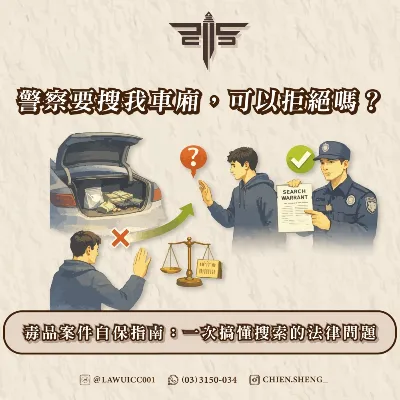 警察要搜車廂可以拒絕嗎?毒品案件遇到臨檢、同意搜索與違法搜索自保指南警察臨檢要求搜索車廂、包包或身體時,不是任何情況都一定要同意。毒品案件中,搜索是否合法可能直接影響扣案證據能不能使用。本文一次解析搜索票、同意搜索、拒絕方式與違法搜索的自保重點。毒品案件知識文 2026.06.09