1. Why Does Hiring an Underage Hostess Create Legal Risks in Taiwan?
Taiwanese law specifically protects children and adolescents from being placed in hostess work involving drinking with customers and certain sexually suggestive entertainment activities.
For business operators, the legal risk is not limited to arranging prostitution or other sexual transactions. The nature of the work itself may bring the situation within child and youth protection legislation.
1.1 Article 45 of the Child and Youth Sexual Exploitation Prevention Act
Article 45 of Taiwan’s Child and Youth Sexual Exploitation Prevention Act provides administrative and criminal penalties relating to children or adolescents performing hostess work involving drinking with customers, sexually suggestive companionship, singing, dancing, or similar activities.
Under Paragraph 1, causing a child or adolescent to engage in covered activities may result in an administrative fine of NT$200,000 to NT$2 million and an order to make improvements within a specified period. Failure to comply may lead to a business suspension of one month to one year. Under Paragraph 2, recruiting, inducing, accommodating, mediating, assisting, or otherwise causing a child or adolescent to perform the specified activities may result in imprisonment of up to one year, with an additional fine of up to NT$300,000.
➟The provision also addresses more serious conduct involving coercion, deception, or other methods contrary to the young person’s wishes, as well as profit-related aggravation and attempted offenses.
1.2 Does the Law Apply Without Sexual Transactions?
➥Yes.
The covered conduct expressly includes hostess work involving drinking with customers. A sexual transaction is not a necessary element of that category.Consequently, assigning a person under 18 to sit with customers, drink alcohol, and provide hostess services may create legal exposure even if no prostitution, sexual contact, or other sexual activity occurs.
The relevant legal assessment depends on the actual duties performed and the applicable statutory provisions, rather than merely the business’s description of the position.
1.3 Does Being Deceived Automatically Eliminate Liability?
No. An applicant’s use of false identification does not automatically prevent an investigation or eliminate every form of legal responsibility.
However, it is equally important not to treat an employer’s liability as automatic merely because the worker was under 18. Administrative liability and criminal liability involve different legal requirements, and the alleged criminal offense must be assessed according to its statutory elements and applicable rules concerning intent.The operator’s knowledge, verification procedures, surrounding circumstances, and response after discovering the deception may all be relevant.
💡A business should therefore establish procedures capable of demonstrating how an applicant’s identity and age were checked before work began.
2. How Should Hostess Clubs Verify an Applicant’s Age?
A reliable age-verification procedure should be completed before an applicant is assigned any duties involving hostess services or drinking with customers.
The purpose is not merely to collect identification documents. It is to determine whether the documents reasonably establish that the applicant is the person they claim to be and has reached the required age.
2.1 Compare Identification Documents and Photographs
Employers should inspect the applicant’s original identification document rather than relying solely on a photograph sent through a messaging application. The photograph, name, date of birth, and other relevant details should be compared with the person attending the interview. Where reasonably necessary, an additional identity document may help resolve discrepancies. Examples include a National Health Insurance card or another official document containing identifying information.
However, multiple documents are not automatically reliable if they originate from the same false identity or belong to another person. Employers should examine whether the information is consistent and whether the applicant reasonably resembles the person shown in the documents.
An applicant presenting a family member’s identification card may be detected through differences in facial appearance, identifying details, or responses during the interview.
2.2 Verify Date of Birth and Resolve Inconsistencies
An employer should calculate the applicant’s age using the actual date of birth, rather than relying on a verbal statement that the applicant is already an adult.
If the identification documents contain conflicting information, the employer should suspend the hiring process until the discrepancy is resolved.
Where additional verification is justified, the applicant may be asked to obtain an appropriate household registration document through lawful procedures. A household registration transcript may contain official birth information, but employers should request only the information reasonably necessary for verification. A transcript is not automatically required for every applicant, and possession of a document does not guarantee that it is genuine.
🚨An employer generally cannot independently access another person’s household registration information without a lawful basis or authorization. If the applicant cannot establish their age through reliable documentation, the business should not assign them to age-restricted work.
2.3 Establish a Consistent Hiring Procedure
Age verification should be a documented business procedure rather than an informal decision made by whichever manager happens to conduct the interview.
A practical procedure may include checking original identification, comparing identifying details, confirming the applicant’s date of birth, recording the verification result, and obtaining management approval before work begins. Employees responsible for recruitment should also know how to respond to suspicious identification documents or inconsistent personal information.
➟Where doubts remain, the appropriate response is to delay the assignment rather than allowing the applicant to begin hostess duties while verification is incomplete.
Consistent procedures help prevent mistakes and may provide relevant evidence if the business later needs to explain its hiring decisions.
3. How Can Employers Preserve Evidence of Age Verification?
When an applicant uses a borrowed or forged identification card, the operator may later need to explain why the business believed the person was an adult. Contemporaneous records can help establish what was checked, what information the applicant provided, and what the operator knew at the relevant time.
3.1 Interview Records and Video Documentation
Employers may maintain written interview records documenting the applicant’s stated age, identification documents presented, verification date, and the person who conducted the checks.
Where video recording is considered necessary and lawful, the applicant should be informed about the recording and its purpose before it begins. A recording may show the applicant presenting identification and confirming their date of birth. It may also document the questions asked by the interviewer.
However, recording an interview does not automatically establish that the employer exercised sufficient care or lacked criminal intent. The evidentiary value depends on the full circumstances, including whether the identification was actually examined and whether obvious inconsistencies were ignored.
⚠️Employers should not assume that obtaining consent alone resolves every privacy or personal-data issue.
3.2 Age Declaration and Employment Documents
An age declaration may provide additional evidence that the applicant expressly represented themselves as being at least 18. The document may record the applicant’s name, stated date of birth, date of signing, and acknowledgment that the information supplied during recruitment is accurate.
A signed declaration can help demonstrate what the applicant told the employer. However, it is not a substitute for reasonable identity verification. A statement attempting to transfer all legal responsibility to the applicant cannot override statutory duties or automatically exempt an employer from administrative or criminal liability.
➟The declaration should therefore be treated as one component of a broader verification procedure.
3.3 Personal Data and Privacy Protection
Identification documents, interview recordings, photographs, and household registration information contain personal data. Their collection and use must comply with Taiwan’s Personal Data Protection Act and other applicable requirements.
Employers should establish a legitimate and specific purpose for collecting information, limit the data to what is necessary, inform applicants as required, restrict access, and implement appropriate security measures. Sensitive documents should not be circulated casually through staff messaging groups or retained indefinitely without a lawful purpose.
Where a dispute or investigation arises, relevant records should be preserved securely and disclosed through appropriate legal procedures.
4. What Should an Operator Do After Discovering a Fake ID?
If an operator discovers that an applicant or employee is under 18, or that the identification used during recruitment belongs to another person, the business should act immediately. Continuing the same work arrangement after learning the true circumstances may substantially change the legal assessment of the operator’s conduct.
4.1 Immediately Stop Prohibited Work
The first priority is to prevent the minor from continuing any duties prohibited by the applicable child and youth protection laws.
The business should remove the person from hostess assignments involving drinking with customers or other covered activities. Management should also ensure that relevant staff do not continue assigning the minor to such work while the situation is being reviewed. The young person’s safety and welfare should be considered throughout the response.
4.2 Preserve Documents and Relevant Records
The business should preserve the original recruitment records, identification information lawfully obtained, employment documents, interview records, work schedules, communications, and any relevant surveillance footage. Records should be preserved in their original form wherever possible.
Employers should not alter dates, delete messages, create backdated verification records, or pressure staff or the applicant to provide a particular explanation. A clear timeline should identify when the applicant applied, what documents were presented, when work began, when the discrepancy was discovered, and what action management took afterward.
➟These details may become important during an administrative investigation or criminal proceeding.
4.3 Report Suspected Forgery and Obtain Legal Advice
If there is evidence that an identification document was forged, borrowed without authorization, or used to impersonate another person, the operator should promptly obtain legal advice and consider reporting the suspected offense to the police.
The appropriate reporting and child-protection procedures depend on the facts. Where a minor may have experienced exploitation, the relevant authorities should be contacted through the applicable protection mechanisms.
When making a report, the operator should provide accurate information and preserve supporting records. Reporting suspected deception may help establish the sequence of events and the operator’s response, but it does not automatically eliminate liability for earlier conduct.
5. What Penalties May Apply to Underage Hostess Employment?
A case involving an underage hostess may raise several distinct legal questions. The applicable consequences depend on the person’s conduct, the actual duties performed, the relevant statutory provisions, and the evidence establishing each alleged violation.
5.1 Administrative Fines and Business Suspension
Article 45, Paragraph 1 of the Child and Youth Sexual Exploitation Prevention Act provides an administrative fine of NT$200,000 to NT$2 million for causing a child or adolescent to engage in the specified activities.
The authority may also order improvements within a specified period. If the operator fails to make the required improvements, the competent authority may refer the matter to the relevant business authority for suspension of operations for one month to one year.
5.2 Criminal Liability and Profit-Related Aggravation
Article 45, Paragraph 2 provides criminal penalties for recruiting, inducing, accommodating, mediating, assisting, or otherwise causing a child or adolescent to engage in the specified activities. The prescribed penalty is imprisonment of up to one year, with an additional fine of up to NT$300,000.
Paragraph 3 addresses conduct involving violence, coercion, drugs, deception, hypnosis, or other methods contrary to the person’s wishes, with imprisonment of three to five years and a possible additional fine of up to NT$1.5 million.
Paragraph 4 provides for an increase of up to one-half of the applicable penalty when the offenses specified in the preceding two paragraphs are committed with intent to profit. The provision also punishes attempts involving the offenses identified in its final paragraph.
⚠️The existence of a commercial business does not remove the need to examine the statutory elements of the particular offense and any applicable aggravating provision.
5.3 Other Child Protection and Civil Liability Risks
Depending on the circumstances, an incident may also raise issues under the Protection of Children and Youths Welfare and Rights Act, employment-related laws, or other applicable legislation.
If the minor suffers harassment, physical injury, or other harm during work, the operator may also face potential civil claims. Whether compensation is payable, and in what amount, depends on the relevant legal basis, evidence, causation, and responsibility. If the circumstances involve coercion, trafficking, forced labor, or other exploitation, additional criminal provisions may apply.
These issues require separate assessment rather than assuming that every underage employment case involves the same offenses.
6. How Does Criminal Intent Affect an Employer’s Defense?
One of the most important questions in a criminal investigation is what the operator actually knew when the applicant was recruited and assigned work.
A minor’s use of false identification is relevant, but the legal analysis should not end with either the applicant’s actual age or the operator’s claim of having been deceived.
6.1 Knowledge of the Applicant’s Actual Age
Investigators may examine whether the operator knew that the applicant was under 18 or was aware of circumstances indicating that the applicant’s claimed age was false.
Relevant circumstances may include inconsistent identification details, obvious differences between the applicant and the photograph, contradictory statements, prior warnings from staff, or messages discussing the applicant’s actual age.
The prosecution must establish the elements required for the alleged criminal offense under the applicable rules of criminal law. A business operator should not be presumed criminally guilty solely because an applicant presented false identification and later proved to be a minor. At the same time, deliberately ignoring clear warning signs may undermine a claim of genuine mistake.
6.2 Evidence Supporting Genuine Mistake or Deception
A defense may examine the identification presented, interview records, verification steps, communications, and the operator’s response after discovering the discrepancy. For example, contemporaneous evidence may show that the applicant presented identification belonging to an adult family member, expressly claimed to be over 18, and provided consistent information during recruitment.
The defense should also establish whether the operator retained control over the hiring process and whether any warning signs were known before the applicant began work. A signed age declaration or interview recording may support the account of events, but neither document guarantees non-prosecution or acquittal.
💡The legal significance of the evidence must be evaluated in relation to the particular offense and the complete facts.
7. Case Scenarios: Inadequate Verification vs. Documented Compliance
The following hypothetical scenarios illustrate how different recruitment procedures and responses may affect the evidence available during an investigation. They are not representations of actual judgments or cases handled by Chien Sheng International Law Firm.
7.1 A Minor Uses a Borrowed Identification Card
A hostess club owner interviews an applicant who presents her older sister’s identification card. The document indicates that the holder is 25 years old, but the applicant is actually 16. The owner checks the date of birth without carefully comparing the photograph or identifying details and immediately assigns the applicant to hostess duties. Several months later, police discover her actual age.
The business may face an investigation under Article 45 of the Child and Youth Sexual Exploitation Prevention Act. The fact that the applicant used another person’s identification card may be relevant to the operator’s defense. However, investigators may also examine the adequacy of the verification procedure, any obvious inconsistencies, and what the owner actually knew.
⚠️Whether administrative or criminal liability is established depends on the applicable legal requirements and evidence. It cannot be determined solely from the fact that the applicant deceived the employer.
7.2 An Employer Detects Inconsistent Documents
In another hypothetical situation, a hostess club operator requires an applicant to present original identification and checks the information against an additional official document.
The applicant’s identification card indicates that she is 23, but the additional document shows a date of birth corresponding to an age of 17. The operator notices the discrepancy, suspends recruitment, and does not assign the applicant to hostess duties. The business preserves the relevant application records and seeks appropriate advice about the suspected misuse of identification.
These steps may help establish that the operator detected the inconsistency before assigning prohibited work and took action to prevent the minor from performing it.
💡The key distinction is not simply the number of documents collected. It is whether the verification procedure identified the problem and whether the operator responded appropriately.
8. What Should Employers Do During a Police Investigation?
If police contact a hostess club regarding an underage worker, the operator should first identify the nature of the investigation and the capacity in which they are being questioned.
Before attending an interview, the business should organize the applicant’s recruitment documents, identification records, employment arrangements, work schedules, relevant communications, and any available interview recordings. The operator should also prepare a chronological account showing when the applicant applied, what information was supplied, how identity was checked, when work began, and when the true age was discovered.
Statements should accurately reflect the facts. An operator should not speculate about matters they do not remember or attempt to coordinate misleading explanations with employees. If the investigation concerns suspected criminal conduct, obtaining advice from a criminal defense lawyer before questioning may help clarify the legal issues and ensure that relevant evidence is properly presented.
➟The first statement can become an important part of the investigation. Providing a complete and accurate account at an early stage may help prevent misunderstandings about the operator’s knowledge and conduct.
9. How Can a Taiwan Criminal Defense Lawyer Assist?
Cases involving underage hostess employment may require analysis of criminal law, administrative penalties, child and youth protection legislation, employment practices, and personal-data requirements. A criminal defense lawyer can assist the operator in identifying the specific allegations and distinguishing the different legal requirements that apply.
Legal assistance may include reviewing recruitment procedures, examining identification records, reconstructing the timeline, assessing evidence of criminal intent, accompanying the client during police or prosecutor questioning, and preparing written defense submissions. If the applicant used forged or borrowed identification, the lawyer may also help assess the legal significance of that deception and identify evidence supporting the operator’s account.
Where administrative penalties are imposed, counsel may review the decision and assess the available remedies under the applicable procedures and deadlines.
The appropriate defense must be based on the actual evidence and statutory requirements. Neither an applicant’s false statement nor an employer’s signed age declaration guarantees a particular outcome.
10. Frequently Asked Questions About Underage Hostess Employment in Taiwan
Q1. Can a hostess club be penalized if a minor uses a fake ID?
Yes. A business may face an investigation and potential administrative or criminal consequences if a person under 18 performs activities covered by Article 45 of the Child and Youth Sexual Exploitation Prevention Act. The applicant’s deception is relevant, but it does not automatically eliminate every form of liability.
Q2. Is hostess work involving drinking with customers prohibited for minors even without sexual activity?
Yes. Article 45 expressly covers children or adolescents engaging in hostess work involving drinking with customers. A sexual transaction is not required for that category of conduct.
Q3. What is the penalty for allowing a minor to perform hostess duties?
Under Article 45, Paragraph 1, the administrative fine is NT$200,000 to NT$2 million, together with an improvement order. Failure to comply with the order may lead to a business suspension of one month to one year. Separate criminal penalties may apply when the relevant criminal elements are established.
Q4. Is checking a national identification card enough?
Checking original identification is an important starting point, but employers should also examine whether the photograph and identifying details correspond to the applicant. Where discrepancies arise, additional verification should be completed before the applicant is assigned age-restricted duties.
Q5. Can an employer require a household registration transcript?
An employer may request appropriate supporting information where there is a legitimate and lawful verification purpose. However, personal-data requirements must be respected, and only reasonably necessary information should be collected. A household registration transcript is not automatically required for every applicant.
Q6. Does a signed age declaration protect the employer from prosecution?
Not automatically. A signed declaration may help establish that the applicant claimed to be an adult, but it cannot override statutory obligations or replace reasonable identity verification.
Q7. Should employers record job interviews?
Appropriate interview records may help document the verification process. If video recording is used, the employer should establish a lawful purpose, provide the required information to the applicant, and comply with applicable privacy and personal-data requirements. Recording should not be treated as a substitute for checking identification.
Q8. What should an operator do after discovering that an employee is under 18?
Immediately stop assigning the person to prohibited duties, preserve relevant records, protect the young person’s welfare, and seek appropriate legal advice. Where identification misuse or exploitation is suspected, the operator should consider the applicable police-reporting and child-protection procedures.
Q9. Can an employer argue that they did not know the applicant was a minor?
An employer may present evidence concerning their actual knowledge, the identification supplied, the verification process, and the circumstances of the alleged deception. Whether those facts establish a defense depends on the specific offense and applicable legal requirements.
Q10. When should a hostess club contact a criminal defense lawyer?
Legal advice is particularly important when an applicant’s age cannot be verified, false identification is discovered, police request an interview, or the business receives notice of an administrative or criminal investigation.
Early assistance may help preserve evidence, identify the relevant legal issues, and prepare an accurate explanation of the recruitment process.
11. Conclusion: Age Verification and Early Legal Action
A minor’s use of forged or borrowed identification can create serious legal difficulties for a Taiwanese hostess club. The operator may have believed that the applicant was an adult, yet the discovery of underage hostess work can still lead to administrative proceedings, criminal investigations, and potential civil disputes.
The most effective preventive approach is to establish a consistent recruitment process before assigning applicants to age-restricted duties. Employers should inspect original identification, compare identifying details, resolve inconsistencies, maintain appropriate verification records, and avoid assigning applicants to prohibited work when their age remains uncertain. Interview recordings and signed age declarations may provide useful evidence, but they do not replace genuine verification or automatically exempt the business from legal responsibility.
If an applicant is discovered to be under 18, the operator should immediately stop prohibited duties, preserve relevant evidence, address the young person’s safety, and obtain advice about the appropriate reporting and legal procedures.
For operators already facing police questioning or allegations under the Child and Youth Sexual Exploitation Prevention Act, the defense should focus on the complete factual record, the operator’s actual knowledge, and the statutory elements of the alleged offense.
🧑🏻⚖️Chien Sheng International Law Firm can assist business operators with criminal investigations, evidence review, legal defense submissions, and related administrative or civil issues. Early legal advice may help clarify the available options and protect the operator’s procedural rights.The central principle is straightforward: age verification should be completed before work begins, and any discovery of false identification should be addressed promptly, accurately, and in accordance with the law.
【CHIEN SHENG LAW FIRM】
- LINE Online Legal Consultation::@lawuicc001(Click to Consult)
- Appointment by Phone::(03)⠀3150-034
- Payment Methods: Cash|Credit Card|Bank Transfer
【Learn More】

 車禍有診斷證明就一定構成過失傷害嗎?法院無罪判決與傷害因果關係解析有診斷證明,不代表車禍過失傷害一定成立。法院還會檢視碰撞力道、車損程度、當場有無表示受傷、就醫時間,以及診斷內容能否證明傷勢確實由事故造成。本文從一件輕微車禍無罪判決解析關鍵證據。刑事案件知識文 2026.09.14
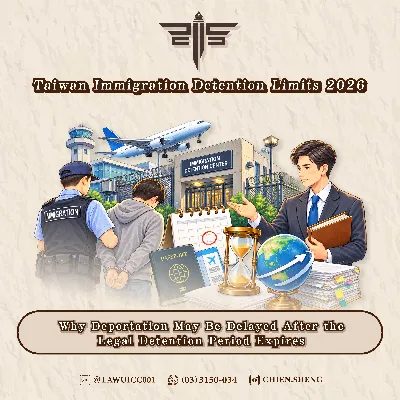 Taiwan Immigration Detention Limits 2026: Why Deportation May Be Delayed After the Legal Detention Period ExpiresWhy must Taiwan release some foreign nationals even when their deportation remains incomplete? Immigration detention is subject to statutory limits and constitutional protections. This guide explains the 100-day detention framework, separate rules for Mainland Chinese residents, common deportation delays, humanitarian safeguards, and alternatives to detention under Taiwanese law.刑事案件知識文 2026.10.19
 政府採購法違反會被判刑嗎?圍標、借牌投標、陪標、洩密罪與刑事辯護完整解析政府採購圍標、借牌投標、陪標會被判刑嗎?同業合作、相同IP投標或工程圖說外流,是否就代表犯罪?本文解析政府採購法第87條、第89條及常見違法態樣,說明行政異常與刑事責任的界線,以及企業面臨檢調調查時的法律辯護方向。刑事案件知識文 2026.10.19
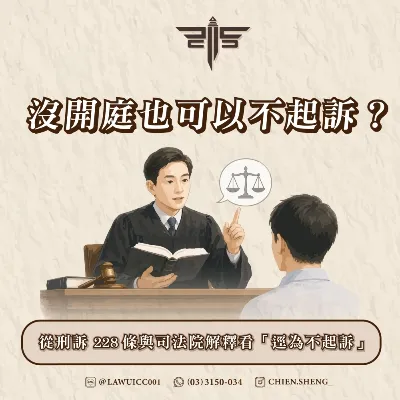 沒收到地檢署傳票也會不起訴?解析「逕為不起訴」、刑事訴訟法第228條與不起訴處分流程沒收到地檢署傳票、一次偵查庭都沒開,竟然可以直接不起訴?本文解析「逕為不起訴」的法律依據,說明《刑事訴訟法》第228條、司法院院字第403號解釋,以及哪些刑事案件可能在警詢後就由檢察官直接作成不起訴處分。刑事案件知識文 2026.09.03