1. Can Someone Be Convicted of a Drug Crime Just Because Another Person Accuses Them?
A person may become the subject of a drug investigation because a buyer, drug user, or co-defendant identifies them as a seller or accomplice. That accusation can be significant evidence and may lead to further investigation.
However, being accused is not the same as being proven guilty.Taiwan criminal procedure requires courts to determine criminal facts based on evidence. The prosecution bears the burden of proving the charged offense, and the defendant does not become responsible for proving innocence merely because another person has made an accusation.
1.1 Presumption of Innocence Under Taiwan Criminal Procedure
Article 154 of the Code of Criminal Procedure provides that a defendant is presumed innocent until proven guilty by final judgment and that criminal facts must be established by evidence. A criminal fact cannot be found without evidence. This principle is especially important in drug cases because alleged transactions frequently occur in private and may leave limited direct evidence.
A prosecution may therefore rely on a combination of witness statements, communications, financial records, seized items, forensic reports, surveillance footage, location information, and digital evidence.
But the absence of direct video footage does not automatically mean the defendant must be acquitted, just as the existence of an accusation does not automatically justify conviction. The court must evaluate the entire evidentiary structure.
1.2 The Prosecutor Bears the Burden of Proof
Article 161, Paragraph 1 of the Code of Criminal Procedure provides that the prosecutor bears the burden of proving the defendant’s criminal conduct and must identify the methods of proof. Accordingly, a defendant does not have to establish innocence simply because the prosecution presents an accusation. The prosecution must present sufficient evidence to establish the charged criminal facts.
If the evidence, viewed as a whole, still leaves reasonable doubt about whether the alleged drug transaction occurred or whether the defendant was the person responsible for it, that uncertainty cannot simply be resolved against the defendant.
➙This principle becomes particularly important when the prosecution’s case depends heavily on a drug buyer or co-defendant whose own interests may be affected by the investigation.
2. What Is Corroborating Evidence in a Taiwan Criminal Case?
“Corroborating evidence” is a central concept when a drug prosecution relies heavily on confessions or accusations made by defendants or accomplices. It does not mean that prosecutors must always produce a video recording that independently captures every element of the crime.
Instead, corroboration serves as an external check on the reliability of a statement.
2.1 Why a Confession Cannot Stand Alone
Article 156 of the Code of Criminal Procedure provides that a defendant’s confession may be admitted as evidence when it was not obtained through violence, threats, inducement, fraud, fatigue interrogation, unlawful detention, or other improper methods and when it corresponds with the facts.
More importantly, Article 156, Paragraph 2 provides that the confession of a defendant or accomplice cannot serve as the sole evidence supporting a guilty judgment. Other necessary evidence must still be investigated to determine whether the confession corresponds with reality. The purpose is to reduce the risk of conviction based solely on an unverified statement.
A person may confess or accuse another person for many reasons. The statement may be truthful, but it may also be affected by mistaken memory, pressure, misunderstanding, an attempt to shift responsibility, or an expectation of favorable treatment.
➙For that reason, the evidentiary analysis does not stop with the statement itself.
2.2 Corroborating Evidence Does Not Have to Prove the Entire Crime
Corroborating evidence does not necessarily have to independently establish every element of the alleged offense. If a separate piece of evidence already proved the entire drug transaction by itself, the need to discuss it merely as “corroboration” would often be less significant. The real function of corroborating evidence is to provide support outside the relevant confession or accusation and to demonstrate that the statement is not simply fabricated or disconnected from objective reality.
The evidence must have a meaningful relationship with the criminal facts that require proof. Depending on the case, corroboration may relate to the identity of the parties, the time or location of the alleged transaction, communications between them, payment, possession or delivery of drugs, or other important circumstances.
2.3 What Evidence May Corroborate a Drug Transaction?
Potential corroborating evidence in a Taiwan drug case may include communications or message content obtained through lawful procedures, bank transfers and other financial records, surveillance footage, location or movement information, seized drugs, packaging materials, forensic reports, independent witnesses, and third-party digital records.
But no category of evidence is automatically sufficient merely because it exists. A phone call proves that a communication occurred, but not necessarily what was discussed. A bank transfer proves that money moved, but not necessarily that the money was payment for drugs. Surveillance footage may show two people meeting, but not necessarily what was exchanged.
🧑🏻⚖️The court must therefore examine both the existence of the evidence and its actual connection to the alleged drug transaction.
3. Does a Drug Buyer’s Identification Require Corroboration?
Drug trafficking investigations often begin when a person caught possessing or using drugs tells investigators who allegedly supplied them. Such a statement can become highly significant because it may transform another person from an unknown individual into a suspected drug seller.
But a buyer’s identification must still be carefully evaluated rather than accepted simply because it is specific or detailed.
3.1 Why Buyer Statements Require Careful Review
A drug buyer may be able to provide first-hand information about a transaction. That can make the buyer an important witness. At the same time, the circumstances surrounding the statement matter.
The buyer may themselves be under criminal investigation. They may be attempting to explain possession of drugs, minimize their own role, cooperate with investigators, or identify a drug source in an effort to obtain a legally available sentencing benefit. None of these circumstances automatically proves that the buyer is lying.
➙They do, however, explain why courts must examine whether the accusation is supported by other evidence and whether the statement remained consistent throughout the investigation and trial.
3.2 Sentence Reduction Incentives Under Article 17
Article 17, Paragraph 1 of the Narcotics Hazard Prevention Act provides that a person who commits an offense under Articles 4 through 8, 10, or 11 and identifies the source of the drugs, thereby enabling authorities to apprehend another principal offender or accomplice, shall receive a reduced sentence or exemption from punishment. Simply naming another person is not enough. The information must lead to the apprehension of another principal offender or accomplice.
Article 17, Paragraph 2 separately provides a sentence reduction for a person who commits an offense under Articles 4 through 8 and confesses during the investigation and throughout each stage of trial. Article 17 also contains a separate provision concerning a defendant who commits the offense of transporting drugs under Article 4 for their own use and whose circumstances are minor. These provisions create legally authorized mechanisms for sentence reduction. They do not mean that every person seeking the benefit will make a false accusation.
💡However, when evaluating credibility, the defense may legitimately examine whether the accusing person had a potential sentencing interest and whether objective evidence independently supports the accusation.
3.3 A Detailed Accusation Is Not Automatically a Reliable Accusation
An accusation can sound convincing because it contains a date, location, drug quantity, price, nickname, vehicle, or communication method. Specificity can be relevant to credibility, but it is not a substitute for verification. A defense lawyer should ask whether the details remained consistent across the buyer’s police interview, prosecutor questioning, and court testimony. The defense should also determine whether objective evidence confirms those details.
If the buyer claims to have purchased drugs at a particular location on a particular date, the relevant questions may include whether the parties actually communicated that day, whether location or surveillance records are consistent with the account, whether the alleged payment can be identified, and whether other evidence connects the defendant to that specific transaction.
⚠️The more serious the allegation, the more important it is to distinguish a detailed accusation from a verified accusation.
4. Can Co-Defendants’ Confessions Corroborate Each Other?
Drug prosecutions frequently involve multiple defendants. One defendant may admit participating in the offense and accuse another defendant of handling communications. Another may admit being present but claim that someone else supplied the drugs. These statements can be relevant evidence, but multiple confessions do not automatically solve the corroboration problem.
4.1 Why Two Similar Confessions Are Not Automatically Independent Evidence
Suppose Defendant A says, “Defendant B contacted the buyer,” while Defendant B says, “Defendant A supplied the drugs.” The fact that both defendants have made incriminating statements does not automatically transform the two statements into independent objective evidence.
Where the statements remain confessions or accomplice statements arising from participants on the same side of the alleged criminal activity, courts must still consider the corroboration requirements applicable to such evidence. Two statements may be consistent and still originate from people who share similar incentives to minimize their own roles or shift responsibility.
⚠️Consistency is relevant, but it is not the same thing as independence.
4.2 The Problem of Circular Corroboration
A criminal case should not be established through purely circular reasoning.
The prosecution cannot simply argue that Defendant A proves Defendant B’s statement and then use Defendant B’s unverified statement to prove Defendant A’s statement without examining whether evidence outside that circle supports the alleged criminal facts. Otherwise, two unverified accusations could appear stronger merely because they repeat each other.
The key question is whether there is evidence independent from the relevant confession or accusation that supports the facts being asserted. Depending on the case, that external support might include messages, money transfers, surveillance footage, location information, seized drugs, forensic evidence, or another genuinely independent evidentiary source.
4.3 External Evidence Still Matters
Corroboration is not a mechanical formula. Courts may consider the circumstances in which statements were made, whether they were spontaneous and independently formed, whether the speakers had opportunities to coordinate their accounts, whether the statements contain details that could only be known through actual participation, and whether objective evidence supports important parts of the account.
But the defense should resist an argument that multiple accusations automatically become reliable simply because their wording is similar.
💡The central issue remains whether the prosecution’s evidence, considered as a whole, reliably establishes the charged offense.
5. What Are Opposing-Party Offenses in Taiwan Drug Cases?
Drug transactions may involve parties who stand on opposite sides of the same transaction. The most obvious example is the alleged seller and buyer. Understanding this structure is important because it differs from a situation involving several people jointly operating on the seller’s side.
5.1 The Buyer and Seller Are on Opposite Sides of the Transaction
In a drug transaction, the seller and buyer generally perform different but corresponding conduct. The seller may be accused of selling or transferring drugs, while the buyer may separately face criminal consequences for possession, use, or other conduct depending on the facts and drug classification.
They are therefore not necessarily joint principals committing the seller’s offense together merely because both participated in the same transaction. This distinction is sometimes described through the concept of opposing-party or reciprocal offenses.
➙However, identifying the parties as being on opposite sides of a transaction does not eliminate ordinary evidentiary safeguards.
5.2 Can Buyer and Seller Statements Corroborate Each Other?
This issue requires particular care. The fact that the buyer and seller each make statements adverse to their own interests may be relevant when evaluating credibility. Their accounts may also correspond on important transaction details.
But it is too broad to say that opposing-party statements automatically constitute sufficient corroboration for each other. Taiwan Supreme Court reasoning concerning accomplice confessions emphasizes that the corroboration requirement may extend to necessary accomplices, including persons involved in opposing-party offenses. Statements that remain materially the same confession evidence may constitute cumulative evidence rather than the separate corroborating evidence contemplated by Article 156.
Accordingly, courts must examine the specific criminal structure, the nature of each statement, how independently the statements were made, the risks of blame-shifting or sentence-reduction incentives, and whether evidence outside the statements supports the alleged transaction.
➙The proper question is therefore not simply, “Did both sides admit the transaction?”It is whether the complete evidentiary record provides sufficiently reliable support for the criminal facts alleged.
5.3 Joint Sellers Must Be Distinguished From the Buyer-Seller Relationship
This distinction becomes even more important when several people allegedly operate together on the seller’s side. Suppose one person contacts customers, another collects payment, another stores the drugs, and another makes the delivery. Those individuals may be alleged to be joint principals or accomplices on the same side of the criminal activity.
Their statements about one another should not be treated as independent external evidence merely because a separate buyer exists on the opposite side of the transaction. A defense lawyer must first identify where each person sits within the alleged criminal structure. Only then can the evidentiary value of each statement and the need for corroboration be properly analyzed.
6. What Types of Evidence Can Corroborate an Alleged Drug Sale?
Corroborating evidence can take many forms. The important issue is not whether prosecutors can place an item into one of several familiar categories. The issue is whether the evidence genuinely supports an important part of the alleged transaction.
6.1 Communications and Digital Evidence
LINE, Telegram, Messenger, text messages, call records, social-media accounts, mobile phone notes, and cloud data may become relevant evidence. Actual message content can sometimes reveal discussions concerning quantity, price, delivery, meeting arrangements, or coded language.
Call logs without content are more limited. They may prove that two people communicated at a certain time but ordinarily do not reveal what was discussed.
Even where coded language is alleged, the meaning of the conversation must be evaluated in context rather than assumed. A defense lawyer should compare the communication with the alleged transaction date, location, payment, and other evidence.
6.2 Money Transfers and Financial Records
Bank transfers, electronic payments, cryptocurrency transactions, withdrawals, deposits, and other financial records may be used to support an alleged drug transaction.
But the existence of money moving between two people does not automatically prove that the money was drug proceeds. There may be another explanation, such as a loan, repayment, purchase, shared expense, business transaction, or unrelated transfer. The amount, timing, recipient, account history, and surrounding communications should therefore be examined together.
➙If the prosecution alleges that a buyer paid NT$10,000 for drugs but the financial record shows a different amount on a different date, the inconsistency may become relevant to the credibility of the accusation.
6.3 Surveillance, Location, and Movement Records
Surveillance footage, vehicle records, access-control data, mobile location information, and other movement records may help determine whether the accused and the buyer were in the same area at the relevant time.
Such evidence can be valuable, but its limitations matter. A surveillance camera may show two people meeting without showing what was exchanged. Location information may place a phone within a general area without proving that its owner entered a particular building or completed a drug transaction.
➙The defense should therefore distinguish between evidence of presence and evidence of criminal conduct.
6.4 Seized Drugs and Forensic Evidence
Seized drugs, packaging materials, electronic scales, bags, tools, fingerprints, DNA, and laboratory reports may support aspects of a drug prosecution. But the connection between the seized item and the particular defendant or transaction must still be established.
Drugs seized from a buyer prove that the buyer possessed the seized substance. That fact alone does not necessarily prove who supplied it. Similarly, the fact that a defendant possessed the same type of drug does not automatically establish that the defendant sold the specific drugs found on the buyer. The evidentiary chain must be examined carefully.
6.5 Independent Witnesses and Third-Party Records
Evidence from sources independent of the defendants may also provide corroboration. Examples may include witnesses who observed relevant conduct, store records, hotel or accommodation records, transportation records, logistics information, access records, or data maintained by independent third-party platforms.
⚠️The reliability, admissibility, and relevance of each item must still be evaluated individually. There is no rule that one independent record automatically makes an accusation sufficient for conviction.
7. Is a Phone Call, Money Transfer, or Seized Drug Enough to Prove Drug Dealing?
Not necessarily.
Drug cases frequently involve a prosecution theory such as “buyer identification plus call records” or “co-defendant statement plus seized drugs.”But criminal evidence is not evaluated simply by counting the number of items in the case file.
7.1 Evidence Must Be Connected to the Specific Alleged Transaction
- A phone record may show communication but not its content.
- A financial transfer may show payment but not its purpose.
- A surveillance image may show a meeting but not what was exchanged.
- Drugs seized from a buyer may establish possession but not their source.
- Drugs seized from the accused may establish possession but not necessarily sale to the particular buyer named in the indictment.
For evidence to meaningfully corroborate an accusation, the court must examine how that evidence relates to the specific criminal fact that requires proof. A weak connection should not become strong merely because prosecutors describe the item as “corroborating evidence.”
7.2 The Number of Pieces of Evidence Is Not the Test
Five weak pieces of evidence do not automatically become sufficient proof simply because there are five of them. The court must consider their quality, reliability, relevance, and combined evidentiary effect. For example, a buyer’s accusation, several unanswered phone calls, proof that the parties knew each other, and drugs seized from the buyer may create suspicion.
But the ultimate question is whether those facts, considered together with the entire record, establish the specific charged transaction to the required criminal standard of proof. Conversely, a single highly probative piece of independent evidence may sometimes provide substantial corroborative value.
💡The analysis is qualitative, not merely numerical.
8. How Should a Defense Lawyer Challenge Buyer and Co-Defendant Accusations?
When a defendant is accused of drug trafficking, transfer, transportation, or joint distribution based heavily on statements from buyers or co-defendants, the defense should return to the details of the evidentiary record.
The central question is not simply how many people have accused the defendant. The defense should determine what each person actually said, when they said it, why their account changed if it did, what potential interests they had, and what objective evidence genuinely supports the accusation.
8.1 Compare Every Statement
The defense should compare the buyer’s or co-defendant’s police interviews, prosecutor statements, detention-hearing statements, and court testimony where available. Important details include the defendant’s identity, transaction date, location, drug type, quantity, price, payment method, method of delivery, communication channel, and the alleged role of each participant.
Minor differences do not automatically destroy credibility. But substantial changes involving essential facts may require explanation. The defense should also examine whether later details appeared only after investigators obtained additional information or after the speaker became aware of potential sentencing benefits.
8.2 Reconstruct Each Alleged Transaction
Each alleged transaction should be analyzed separately. For every date identified by the prosecution, the defense may examine where the defendant was, whether the parties communicated, whether they met, why they met, whether money changed hands, whether surveillance or location records exist, and whether the objective timeline matches the accusation.
This approach can reveal important inconsistencies. For example, a buyer may remember a transaction as occurring on one date while communication or location evidence suggests that the parties were elsewhere. Alternatively, objective evidence may confirm part of the buyer’s account while leaving the alleged purpose of the meeting unresolved.
⚠️The defense should identify precisely what is proved and what remains an inference.
8.3 Test the Prosecution’s Claimed Corroborating Evidence
A prosecutor may describe a phone record, transfer, surveillance image, or seized item as corroborating evidence.
- The defense should ask a more specific question: What exactly does this evidence corroborate?
- Does it establish that the defendant and buyer knew each other?
- Does it establish communication?
- Does it establish that they met?
- Does it establish payment?
- Or does it actually connect the defendant to the delivery or sale of a particular drug on the date charged?
These are not equivalent propositions.
A careful criminal defense should prevent evidence with a limited meaning from being used to support a broader conclusion than it can reasonably prove. Where the prosecution cannot establish the charged offense through sufficient admissible and reliable evidence, the defense may argue for non-prosecution during the investigation or acquittal after the case proceeds to trial.
9. Frequently Asked Questions About Corroborating Evidence in Taiwan Drug Cases
Q1 Can I be convicted if only one drug buyer says I sold them drugs?
A buyer’s accusation may be important evidence, but the court must evaluate whether the statement is reliable and whether the evidentiary record provides sufficient support for the alleged transaction. A single accusation does not automatically establish guilt merely because the buyer identifies the defendant by name.
Q2 What is corroborating evidence in a Taiwan drug case?
Corroborating evidence is evidence outside the relevant confession or accusation that supports the reliability of the criminal facts described in that statement. It does not necessarily need to prove the entire offense independently, but it must have a meaningful relationship with the facts requiring proof.
Q3 Can phone records be corroborating evidence?
Potentially. Phone records may establish that two people communicated at a particular time. However, without content, they generally do not by themselves establish that the conversation concerned a drug transaction. Their significance depends on how they relate to the other evidence.
Q4 Can a money transfer prove that drugs were sold?
Not automatically. A transfer establishes that money moved between accounts, but its purpose must still be determined. The prosecution may attempt to connect the amount and timing to the alleged drug sale, while the defense may present evidence of another legitimate explanation where supported by the facts.
Q5 If two co-defendants both accuse me, is that enough corroboration?
Not automatically. Multiple co-defendant statements do not necessarily become independent corroborating evidence simply because they are consistent. Courts must examine the nature of the statements, the criminal relationship among the speakers, how independently the statements were made, and whether external evidence supports the alleged criminal facts.
Q6 Can a buyer’s statement and seller’s statement corroborate each other?
Their corresponding statements may be relevant to the overall evidentiary assessment, particularly where each person makes statements adverse to their own interests. However, it is too broad to assume that buyer and seller statements automatically satisfy the corroboration requirement merely because they come from opposite sides of the transaction. The specific offense structure, independence and reliability of the statements, and external evidence must still be examined.
Q7 Why does Article 17 of the Narcotics Hazard Prevention Act matter?
Article 17 provides sentence-reduction mechanisms in specified drug cases. Among other requirements, a person who commits certain drug offenses and identifies the source of the drugs, thereby enabling authorities to apprehend another principal offender or accomplice, may receive a reduced sentence or exemption from punishment.
This potential benefit does not automatically make an accusation false, but it may be relevant when evaluating the speaker’s motivation and credibility.
Q8 Does a buyer receive a sentence reduction just for naming a supplier?
No. Under Article 17, Paragraph 1, simply naming someone is not enough. The information must satisfy the statutory requirements, including leading to the apprehension of another principal offender or accomplice.
Q9 If drugs were seized from the buyer, does that prove I supplied them?
Not by itself. The seizure can establish that the buyer possessed the drugs, subject to the relevant evidentiary findings, but the prosecution must still establish the connection between those drugs and the person alleged to have supplied them.
Q10 What should I do if a buyer or co-defendant falsely accuses me of selling drugs?
Preserve potentially relevant communications, financial records, location information, photographs, schedules, and other original records. Do not delete or alter evidence or attempt to pressure the accusing person to change their statement.
Because drug trafficking and related offenses can carry severe penalties, early review by a criminal defense lawyer can help identify inconsistencies in statements, examine the alleged corroborating evidence, reconstruct the transaction timeline, and determine what evidence may support the defense.
10. Conclusion: An Accusation Is Not the Same as Proof
Drug buyer identifications, co-defendant confessions, and statements from persons on opposite sides of a drug transaction can all become important evidence in a Taiwan drug prosecution. But no accusation should be treated as automatically conclusive merely because it appears in a police interview record, prosecutor transcript, or indictment.
Taiwan’s criminal evidence rules require courts to examine whether criminal facts have been established through sufficient evidence. Article 154 of the Code of Criminal Procedure protects the presumption of innocence and requires criminal facts to be established by evidence. Article 161 places the burden of proving the defendant’s criminal conduct on the prosecutor. Article 156 limits reliance on defendant and accomplice confessions and requires other necessary evidence to verify their factual reliability.
🧑🏻⚖️Chien Sheng International Law Firm handles drug-related and other criminal cases involving buyer identifications, co-defendant statements, digital evidence, financial records, disputed confessions, and corroborating-evidence issues.
【CHIEN SHENG LAW FIRM】
- LINE Online Legal Consultation::@lawuicc001(Click to Consult)
- Appointment by Phone::(03)⠀3150-034
- Payment Methods: Cash|Credit Card|Bank Transfer
【Learn More】

 販毒被抓怎麼辦?供出毒品來源一定能減刑嗎?毒品危害防制條例第17條完整解析被抓到販毒,供出上游就一定能減刑嗎?本文解析毒品危害防制條例第17條要件與毒品案件自保重點。毒品案件知識文 2026.05.29
 臉上長出「安痘」會被懷疑吸毒嗎?安非他命生理特徵、警方盤查與毒品案件辯護重點解析臉上長出「安痘」會被警方懷疑吸毒嗎?本文解析安非他命生理特徵、警方盤查與搜索採尿風險,以及毒品案件的辯護重點。毒品案件知識文 2026.06.03
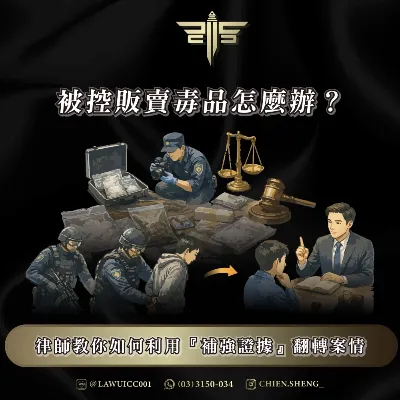 被控販賣毒品怎麼辦?購毒者指證不等於有罪,律師解析補強證據如何成為無罪辯護關鍵販賣毒品案件不能只靠購毒者指證定罪。本文解析補強證據的法律要求,說明如何從證詞矛盾、證據不足與合理懷疑中翻轉案情。毒品案件知識文 2026.06.01
 Charged With a Drug Crime in Taiwan? How to Fight Drug Charges and Seek Acquittal Non-Prosecution or a Reduced SentenceFacing drug charges in Taiwan does not automatically mean conviction. This guide explains defense strategies for drug sales, transportation, manufacturing, possession and use cases, with real case examples involving acquittal, non-prosecution, reduced charges, addiction treatment and suspended sentences.毒品案件知識文 2026.09.22