1. What Happened in the Changhua Drug-Impaired Driving Case?
A reported case in Changhua involved a woman with a lengthy history of drug use, previous incarceration, and a prior drug-trafficking conviction. She was suspected of drug-impaired driving, and prosecutors sought pretrial detention.However, the court initially declined to detain her because the available evidence was considered insufficient.
The case attracted attention because the suspect remained at liberty while authorities awaited additional drug-testing evidence.
1.1 Why the Suspect Was Initially Released
At the initial detention hearing, the court had to assess whether the prosecution had presented sufficient evidence to satisfy the legal requirements for detention.
A preliminary positive saliva drug test can support further investigation, but its evidentiary value must be assessed in light of the testing method, potential false positives, and other available evidence. When confirmatory laboratory results are unavailable, a court may find that the evidence does not sufficiently support the requested detention.
⚠️Importantly, refusing pretrial detention does not mean that the suspect has been acquitted or that the criminal investigation has ended.
1.2 How the Urine Test Affected the Detention Proceedings
According to the reported circumstances, a subsequent positive urine drug test became significant during the prosecution's challenge to the initial detention decision. The Taichung Branch of the Taiwan High Court overturned the original ruling and remanded the matter for reconsideration.
This procedural development did not itself establish guilt or automatically require detention. Rather, it demonstrated how additional forensic evidence can affect a court's assessment of a pending criminal investigation.
➠The case also raised concerns about delays between preliminary roadside testing and the availability of formal laboratory results.
2. How Does Roadside Drug Testing Work in Taiwan?
Drug-impaired driving investigations may involve roadside screening, biological sample collection, laboratory analysis, and additional evidence concerning the driver's conduct. These procedures serve different purposes and should not be treated as interchangeable.
2.1 Saliva Drug Screening and False Positives
Saliva-based rapid drug tests are designed to provide preliminary information about possible drug exposure. They can assist police in determining whether additional investigation or testing is necessary.
However, rapid screening methods may produce false positive results. A false positive occurs when a screening test indicates the possible presence of a drug even though a more specific confirmatory test does not establish the corresponding substance. Testing limitations, cross-reactivity, and the characteristics of the screening method may affect reliability.
⚠️Therefore, a positive saliva screening result should not automatically be treated as conclusive proof of criminal drug use or drug-impaired driving.
2.2 Confirmatory Urine Testing and Laboratory Evidence
Urine testing may provide additional evidence concerning drug exposure, particularly when samples undergo validated laboratory analysis. Confirmatory testing generally offers greater analytical specificity than a preliminary roadside screening test.
However, a positive urine result does not necessarily establish the precise time of drug use, the degree of impairment while driving, or every element of a criminal offense. The interpretation depends on the substance detected, the testing method, the applicable legal requirements, and the surrounding evidence.
3. Can a Positive Saliva Test Prove Drug-Impaired Driving?
A positive saliva drug test may justify further investigation, but it does not automatically establish criminal liability. Taiwanese authorities must distinguish between detecting a substance and proving the elements of the particular offense under investigation.
3.1 Screening Results Versus Criminal Evidence
A roadside screening result is one piece of evidence. Its significance depends on factors such as the device used, whether the required procedures were followed, the circumstances of sample collection, and whether additional evidence supports the result.
When the accuracy of a test is disputed, the defense may examine the testing procedure, laboratory documentation, and any available confirmatory results.
⚠️A false positive can be particularly important when the prosecution relies heavily on a single screening result.
3.2 Drug Detection and the Elements of a Criminal Offense
Drug-impaired driving and unlawful drug use are not necessarily identical offenses. Under Taiwan's Criminal Code, Article 185-3, drug-related driving liability must be assessed according to the applicable statutory requirements, including the relevant circumstances of driving and impairment. Separate allegations involving drug use may arise under the Narcotics Hazard Prevention Act.
A positive biological test must therefore be interpreted in relation to the specific offense charged. Detecting a drug or metabolite does not, by itself, answer every question concerning the driver's condition, timing of use, or criminal responsibility.
4. What Are Taiwan's Legal Requirements for Pretrial Detention?
Pretrial detention is a serious restriction on personal liberty. It is not an automatic consequence of a positive drug test, an arrest, or a prior criminal conviction. Taiwan's Code of Criminal Procedure requires courts to examine statutory detention conditions before ordering custody.
4.1 Strong Suspicion and Statutory Detention Grounds
Under Article 101 of the Code of Criminal Procedure, detention generally requires strong suspicion that the defendant committed an offense, together with an applicable statutory ground for detention and a determination that detention is necessary. Relevant grounds may include risks involving flight, destruction or fabrication of evidence, or collusion, subject to the statutory requirements.
Other detention provisions, including Article 101-1, may apply to certain specified offenses when their separate requirements are satisfied. Consequently, a positive drug test alone does not automatically justify pretrial detention. The court must evaluate the complete legal and evidentiary basis for the prosecution's request.
4.2 Why Prior Criminal Records Are Not Enough by Themselves
A suspect's previous convictions or history of drug use may be relevant to certain aspects of a detention assessment. However, a criminal record does not automatically establish that the suspect committed the new offense. Nor does it eliminate the requirement to establish a lawful basis for detention.
➠Courts must distinguish past conduct from evidence concerning the current accusation and apply the relevant statutory detention standards.
5. Why Do Delayed Drug Test Results Matter?
Delays in obtaining confirmatory laboratory results can affect both criminal investigations and the protection of individual rights. For prosecutors, delayed results may make it more difficult to present timely forensic evidence supporting investigative or compulsory measures. For defendants, uncertainty may prolong the investigation and delay clarification of whether a preliminary positive result was accurate.
The practical concern is therefore not simply whether testing should be faster, but whether results can be obtained promptly while maintaining scientific reliability and procedural safeguards. Expanding qualified laboratory capacity, improving sample-processing procedures, and establishing clear quality-control standards may help reduce delays.
🧑🏻⚖️However, any proposal to authorize additional medical institutions to perform legally recognized confirmatory testing would need to comply with Taiwan's applicable forensic and regulatory requirements.
6. How Can Defendants Challenge Drug-Testing Evidence?
When a person is investigated for drug-impaired driving or another drug-related offense, the reliability and legal use of the evidence may become central issues. A defense should examine both the scientific testing process and the procedures used by investigative authorities.
6.1 Testing Accuracy and Evidence Preservation
Potential defense issues include:
- whether the test was performed correctly
- whether the device or laboratory method was appropriate
- whether samples were properly identified and preserved
- whether the reported results support the prosecution's conclusions
Relevant materials may include screening records, laboratory reports, sample-collection documentation, chain-of-custody records, medication information, and other available forensic evidence. A defendant should not assume that every positive result is incorrect. Equally, authorities should not assume that every preliminary positive result conclusively proves criminal liability. The evidence must be evaluated according to its actual reliability and relevance.
6.2 Police Questioning and Procedural Rights
Drug-related investigations may involve roadside questioning, police interviews, searches, biological sample collection, and prosecutorial questioning.
Statements made during these procedures may later become important evidence. Defendants should provide accurate information, avoid speculation about matters they do not know, and carefully review interview records before confirming their accuracy. Where questions arise concerning the legality of a search, sample collection, or interrogation procedure, legal counsel can evaluate whether a procedural challenge is appropriate.
⚠️Preserving relevant documents and communications without alteration is also important.
7. How Can a Taiwan Drug Crime Lawyer Help?
A criminal defense lawyer can assist in evaluating whether the evidence supports the alleged offense and whether investigative procedures complied with applicable law.
In drug-impaired driving cases, legal assistance may include reviewing roadside screening results, examining confirmatory testing, analyzing the alleged driving conduct, identifying inconsistencies in the evidence, and addressing questions concerning detention or other compulsory measures. Where allegations also involve drug possession, use, trafficking, or manufacturing, the defense must separately analyze the elements and evidence relating to each offense.
Early legal assistance is particularly important when the defendant faces questioning, searches, evidence collection, or a detention hearing. Chien Sheng International Law Firm provides criminal defense services in Taiwan involving drug-related investigations, drug-impaired driving, trafficking, manufacturing, and other criminal allegations.
With offices in Taipei, Taoyuan, and Kaohsiung, the firm assists clients in understanding the charges, preserving relevant evidence, evaluating procedural issues, and developing defense strategies based on the circumstances of their cases.
8. Frequently Asked Questions About Drug-Impaired Driving in Taiwan
Q1: Can a saliva drug test produce a false positive in Taiwan?
Yes. Preliminary saliva drug screening may produce false positive results. The reliability of the result should be assessed according to the testing method, procedures, and available confirmatory evidence.
Q2: Does a positive saliva test automatically mean I committed drug-impaired driving?
No. A positive screening result does not automatically establish every element of a criminal offense. Authorities must evaluate the applicable law and other evidence, including evidence relevant to driving impairment.
Q3: Can I be detained based only on a positive saliva drug test?
Not automatically. Pretrial detention requires the applicable statutory conditions to be satisfied. The court must consider the strength of the evidence, relevant detention grounds, and necessity.
Q4: Is a urine drug test more reliable than a saliva rapid test?
A properly conducted confirmatory laboratory test generally provides greater analytical specificity than a preliminary rapid screening test. However, the meaning of a positive urine result still depends on the substance, testing method, timing, and legal issue being examined.
Q5: Does a positive urine test prove I was impaired while driving?
Not necessarily. A positive urine test may demonstrate drug exposure, but it does not always establish the degree of impairment at the time of driving. Additional evidence and the requirements of the specific offense must be considered.
Q6: Can prescription medication affect a roadside drug test?
Certain medications or substances may interfere with some screening methods. Whether a particular medication can cause a false positive depends on the test and substance involved. Medication records and confirmatory testing may therefore be important.
Q7: What should I do if I believe my drug test result is wrong?
Preserve available test documents, medication records, and relevant communications. Avoid altering evidence, and seek legal advice regarding the testing procedure, available confirmatory evidence, and appropriate ways to challenge the result.
Q8: Can a lawyer help before police or prosecutor questioning?
Yes. Consulting a criminal defense lawyer before questioning can help a defendant understand the allegations, procedural rights, available evidence, and potential legal consequences of statements made during the investigation.
9. Conclusion: Reliable Evidence and Early Legal Defense Matter
Drug-impaired driving investigations in Taiwan involve an important balance between public safety and individual legal rights. Roadside saliva screening can help authorities identify possible drug exposure, but false positives and testing limitations mean that preliminary results must be interpreted carefully. Confirmatory laboratory evidence can strengthen an investigation, yet even a positive urine test must be assessed in relation to the legal elements of the alleged offense.
Pretrial detention also requires an independent judicial assessment. A suspect's prior criminal history, a positive screening result, or public concern about reoffending cannot replace the statutory requirements for detention.
For individuals accused of drug-impaired driving, drug use, or other narcotics offenses, the most important steps are to preserve evidence, understand the specific allegations, examine the reliability of testing procedures, and obtain legal assistance at an early stage.
🧑🏻⚖️Chien Sheng International Law Firm provides criminal defense assistance for drug-related cases in Taipei, Taoyuan, Kaohsiung, and other parts of Taiwan. A case-specific defense strategy can help ensure that forensic evidence, investigative procedures, and criminal liability are evaluated according to the law.
【CHIEN SHENG LAW FIRM】
- LINE Online Legal Consultation::@lawuicc001(Click to Consult)
- Appointment by Phone::(03)⠀3150-034
- Payment Methods: Cash|Credit Card|Bank Transfer
【Learn More】

 麻古是什麼毒品?甲基安非他命分級、持有施用刑責、販賣與轉讓法律風險解析麻古是什麼?持有一顆麻古、幫朋友保管或免費轉讓,也可能觸犯毒品相關法律。本文完整解析甲基安非他命的第二級毒品分級、持有施用刑責、販賣與運輸風險,以及毒品鑑定、觀察勒戒與律師辯護的重要關鍵。毒品案件知識文 2026.10.19
 施用依托咪酯會被判刑嗎?一級毒品刑責、尿檢標準、緩起訴戒癮治療與爭取方式完整解析依托咪酯「喪屍煙彈」升級管制後,施用被抓會直接判刑嗎?驗尿陽性還能爭取緩起訴嗎?完整解析依托咪酯施用、持有刑責、警方與地檢署程序,以及爭取戒癮治療的重要條件與注意事項。毒品案件知識文 2026.09.02
 販毒被抓怎麼辦?供出毒品來源一定能減刑嗎?毒品危害防制條例第17條完整解析被抓到販毒,供出上游就一定能減刑嗎?本文解析毒品危害防制條例第17條要件與毒品案件自保重點。毒品案件知識文 2026.05.29
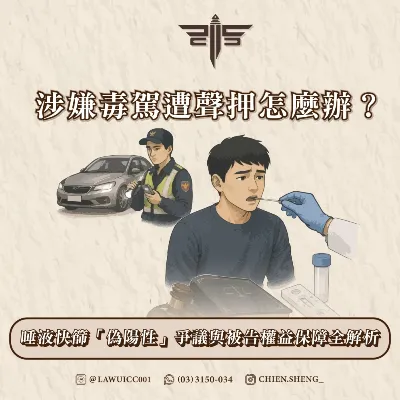 毒駕被聲押怎麼辦?解析唾液快篩偽陽性、尿液檢驗與預防性羈押標準毒駕唾液快篩呈陽性,就一定能被法院羈押嗎?近期彰化毒駕案件因快篩、尿液正式檢驗與預防性羈押引發討論。本文解析唾液快篩偽陽性爭議、尿液檢驗差異、毒駕聲押與羈押要件,以及遭檢察官聲押後,被告與律師可以如何從犯罪嫌疑、再犯風險及檢驗證據保障自身權益。毒品案件知識文 2026.09.09