1. Can Police Use Leading Questions in a Taiwan Drug Investigation?
Police officers investigating a drug case are allowed to ask specific questions in order to clarify the facts. A question such as “Did you purchase drugs from this person at this location?” is not automatically illegal merely because it is direct or closed-ended. The legal concern becomes more serious when investigators do more than clarify an existing statement and instead appear to supply critical information that the person being questioned did not independently provide.
➠For example, there is an important difference between asking a person to describe their drug source and showing them a specific photograph before they have described or identified anyone. The defense must therefore examine the entire questioning process rather than isolating a single question.
1.1 What Taiwan’s Criminal Procedure Code Prohibits
Article 98 of Taiwan’s Code of Criminal Procedure requires that a defendant be questioned in an appropriate manner and prohibits violence, threats, inducement, fraud, fatigue interrogation, and other improper methods. Article 156 further provides that a defendant’s confession may be admitted as evidence only when it was not obtained through violence, threats, inducement, fraud, fatigue interrogation, unlawful detention, or other improper methods and when it is consistent with the facts.
The same provision also states that the confession of a defendant or co-defendant cannot serve as the sole basis for a conviction. Other necessary evidence must still be investigated to determine whether the confession corresponds with the facts.
➠Accordingly, the defense should distinguish between an ordinary investigative question and questioning that may undermine the voluntariness, reliability, or evidentiary value of the resulting statement.
1.2 When Specific Questions Become a Serious Evidentiary Concern
Specific questioning becomes particularly important when the answer appears to originate from the investigator rather than from the person being questioned.
Suppose a person initially says that they do not know the supplier’s real name. If police then repeatedly mention a particular person, display that person’s photograph, suggest a transaction date, and provide a location before obtaining an affirmative response, the defense may have substantial grounds to examine how independently the identification was actually made.
The relevant questions include:
- Who first provided the defendant’s name?
- Who first mentioned the nickname?
- Who supplied the transaction location?
- Did the person describe the accused before seeing a photograph?
- Did investigators repeatedly ask the same question after receiving a negative or uncertain answer?
➠These details can substantially affect how the resulting statement should be evaluated.
2. What Are Common Warning Signs of an Unreliable Drug Accusation?
A drug accusation should not be evaluated only by reading the final written police interview record. The defense should examine how the accusation developed from the beginning of the investigation and whether the person making the allegation consistently possessed independent knowledge of the alleged transaction.
Several patterns deserve particular attention.
2.1 Police Providing a Name or Photograph First
One important question is whether the identifying person independently named or described the accused before investigators provided identifying information.
For example, if a suspect independently states a supplier’s name, nickname, appearance, communication account, vehicle, or other identifying characteristics, that may be materially different from a situation in which police first present one specific person and ask for confirmation.
A defense lawyer may therefore examine the sequence of the identification process rather than looking only at the final answer recorded in the statement. The issue is not simply whether a photograph was used. The question is whether the identification genuinely reflects the person’s own memory and recognition.
2.2 Repeated Suggestions About Dates, Locations, or Transaction Details
Another warning sign may arise when investigators repeatedly provide transaction details until the person being questioned agrees with them.
Drug cases often involve allegations concerning the date of a transaction, the location, the amount of drugs, the purchase price, the method of payment, the vehicle involved, or the communication application used. If those details originated from the person making the accusation, that fact may support the statement’s reliability. If important details were instead supplied by investigators and merely confirmed afterward, the defense may argue that the statement requires more careful scrutiny.
This becomes particularly important when the witness or co-defendant previously gave a materially different account.
2.3 Sentence Reduction Incentives and Cooperation
Taiwan’s Narcotics Hazard Prevention Act contains sentence-reduction provisions that can create strong incentives for defendants to cooperate with investigators.
Under Article 17, Paragraph 1 of the Narcotics Hazard Prevention Act(毒品危害防制條例第17條第1項), a person convicted of certain drug offenses who identifies the source of the drugs and thereby leads authorities to apprehend another principal offender or accomplice may receive a reduced sentence or exemption from punishment. Paragraph 2 separately provides sentence reduction for persons who commit offenses under Articles 4 through 8 and confess during the investigation and throughout each stage of trial.
These statutory incentives are legally authorized. Their existence does not mean that a cooperating defendant is necessarily lying. However, when a person accusing someone else may potentially obtain a substantial sentencing benefit from cooperation, the defense may examine that incentive when assessing the reliability and motivation behind the accusation.
2.4 Statements That Suddenly Become More Detailed
Consistency across statements can be important.
Suppose a person initially says, “I do not know the seller’s name,” but later identifies a specific individual and provides detailed information about several alleged transactions. That change does not automatically prove police misconduct or fabrication. There may be a legitimate explanation, such as newly recovered messages, photographs, transaction records, or refreshed recollection. But if no identifiable new information explains the change, the defense should examine how the additional details emerged.
💡A comparison of every police interview, prosecutor interview, written statement, and court testimony may reveal whether important facts were present from the beginning or appeared only after investigators introduced them.
3. How Can Police Reports and Prior Statements Reveal Problems?
When a drug prosecution depends heavily on another person’s accusation, one of the first defense tasks is to reconstruct the investigative timeline.
Police reports, investigative records, interview transcripts, identification materials, and related documents may help reveal when investigators first became aware of the accused and how the accusation subsequently developed.
3.1 Reconstructing the Investigation Timeline
A criminal defense lawyer may examine police duty reports and investigative records to determine how the defendant first became a target.
Relevant questions include:
- whether the cooperating suspect independently identified the defendant
- whether police already suspected the defendant before the identification occurred
- what information investigators possessed at each stage
Chronology matters. If a police report shows that investigators had already identified a particular person before a witness supposedly “independently” named that person, the defense may investigate whether information was communicated to the witness before the formal statement was taken.
➠This does not automatically invalidate the identification. It does, however, create an evidentiary issue that may require further examination.
3.2 Comparing Every Version of the Accusation
A defense lawyer should not review only the statement that appears most damaging. The first police interview, subsequent police statements, prosecutor questioning, detention hearings, and court testimony should be compared where available. Important differences may involve the number of alleged transactions, dates, locations, drug quantities, prices, payment methods, communication channels, and the defendant’s alleged role.
The defense should also identify information that appears for the first time in later statements. A minor discrepancy does not necessarily destroy credibility. Human memory is imperfect. However, substantial changes concerning essential facts may become important when there is no objective evidence explaining why the account changed.
4. Why Are Police Interview Audio and Video Recordings Important?
A written interview record summarizes spoken communication. It may not fully convey tone, hesitation, interruptions, repeated questioning, or the exact sequence in which information was introduced. For this reason, the original audio or video recording can sometimes be more revealing than the written transcript.
4.1 Taiwan’s Recording Requirements for Defendant Interrogations
Article 100-1 of the Code of Criminal Procedure provides that the questioning of a defendant must generally be continuously audio-recorded throughout the interrogation and, when necessary, continuously video-recorded. An exception applies in urgent circumstances when the reason is recorded in the written interview record. The provision also states that where the defendant’s statement recorded in writing differs from the audio or video recording, the inconsistent portion of the written record cannot be used as evidence, except under the statutory exception.
The exact recording requirements for a witness, related person, or defendant questioned in a separate case may depend on that person’s procedural status, the authority conducting the questioning, and the applicable procedural rules.
💡Accordingly, the existence and legal significance of recordings should be assessed according to the actual circumstances of the case.
4.2 What Lawyers Look for in the Original Recording
When relevant recordings exist, a defense lawyer may request access to them and examine the interrogation in its actual sequence.
The review may focus on questions such as:
- Who mentioned the defendant’s name first?
- Did the person identify the defendant before seeing a photograph?
- Was the answer immediate or hesitant?
- Did the person initially deny knowing the defendant?
- Were transaction details supplied by police before being repeated by the person being questioned?
The lawyer may also examine whether investigators discussed potential sentencing benefits, whether pressure was applied, and whether unexplained interruptions occurred during the recording. These details may not be apparent from the written record alone.
4.3 What Happens When the Written Record and Recording Do Not Match?
A material difference between the written record and the actual recording can become a significant evidentiary issue. For defendant interrogations governed by Article 100-1, the statute specifically addresses discrepancies between the written statement and the audio or video recording.
For example, a written record might appear to show an unequivocal identification, while the recording reveals that the person repeatedly expressed uncertainty before eventually agreeing with the investigator’s suggestion. The defense may use the recording to challenge the completeness, voluntariness, reliability, or evidentiary weight of the written statement, depending on the circumstances and the procedural status of the person questioned.
Where improper interrogation methods are established, additional arguments concerning admissibility may also arise.
5. Is Another Defendant’s Statement Enough to Convict Someone of a Drug Crime?
Being accused by another defendant or alleged accomplice is serious, but the existence of an accusation does not itself establish guilt.
Taiwan’s criminal procedure follows the principle that criminal facts must be established by evidence. Article 154 of the Code of Criminal Procedure provides that a defendant is presumed innocent until proven guilty by final judgment and that criminal facts must be determined based on evidence. Article 156 further provides an important rule concerning confessions by defendants and co-defendants.
5.1 The Corroboration Requirement
Under Article 156, Paragraph 2 of the Code of Criminal Procedure, a confession by a defendant or co-defendant cannot serve as the sole evidence supporting a guilty judgment. Other necessary evidence must be investigated to determine whether the confession corresponds with the facts.
This principle can be particularly important in drug cases where one arrested person identifies another person as the alleged supplier.
⚠️The defense should examine whether there is independent evidence supporting the accusation rather than treating the accusation itself as sufficient proof.
5.2 Objective Evidence in Drug Sale and Supply Cases
Potential corroborating evidence may include communication records, money transfers, surveillance footage, location data lawfully obtained in the investigation, seized drugs, packaging, transaction records, witness testimony, or other evidence connecting the accused to the alleged transaction. The evidentiary significance of each item depends on the facts.
For example, proof that two people communicated does not automatically prove that the communication concerned a drug transaction. Similarly, evidence that two people were in the same location does not by itself establish a sale.
➠A defense lawyer should therefore examine not only whether corroborating evidence exists, but also whether that evidence genuinely supports the specific allegation made by the accusing person.
6. Can Someone Receive a Reduced Sentence for Identifying a Drug Source?
Yes, under specified circumstances. This is particularly relevant when evaluating accusations made by defendants who may themselves be facing serious drug charges.
6.1 Article 17 of the Narcotics Hazard Prevention Act
Article 17, Paragraph 1 of Taiwan’s Narcotics Hazard Prevention Act provides that a person who commits an offense under Articles 4 through 8, 10, or 11, identifies the source of the drugs, and thereby enables authorities to apprehend another principal offender or accomplice shall receive a reduced sentence or exemption from punishment.
The rule requires more than simply naming another person. The information must lead to the apprehension of another principal offender or accomplice. Article 17, Paragraph 2 separately provides that a person who commits an offense under Articles 4 through 8 and confesses during the investigation and throughout each stage of trial shall receive a reduced sentence.
💡These provisions can have significant consequences in serious drug prosecutions.
6.2 Why Cooperation Incentives Matter When Evaluating Credibility
A cooperating defendant’s potential sentencing benefit does not automatically make the person’s statement false. Nevertheless, it can be relevant when evaluating motive and credibility.
If a person originally denied knowing the drug source but later identified a particular defendant after discussing cooperation or sentence reduction, the defense may examine the chronology carefully.
The relevant question is not simply whether Article 17 was mentioned.The defense should determine whether the accusation was independently supported, whether the identifying person had genuine knowledge of the accused, whether the statement remained consistent, and whether objective evidence confirms the alleged transaction.
A lawful sentence-reduction mechanism should not be confused with proof that every accusation made by a cooperating defendant is reliable.
7. What Can a Criminal Defense Lawyer Do During Police and Prosecutor Questioning?
A common misconception is that a defense lawyer attending a police interview or prosecutor interrogation can do nothing more than sit silently beside the defendant. The role of defense counsel is substantially more important.
7.1 Protecting the Defendant’s Procedural Rights
Article 95 of the Code of Criminal Procedure requires defendants to be informed before questioning of matters including the alleged offense, the right to remain silent, the right to retain defense counsel, and the right to request investigation of favorable evidence.
During questioning, defense counsel can monitor whether questions are improperly suggestive, whether pressure is being applied, whether the defendant understands the question, and whether the written record accurately reflects the answer. Depending on the circumstances, counsel may raise procedural objections, request that an objection or clarification be recorded, and advise the defendant concerning the lawful exercise of the right to remain silent.
➠The purpose is not to prevent legitimate investigation. It is to ensure that the defendant’s statement is voluntary, accurate, and properly documented.
7.2 Challenging Inaccurate or Misleading Interview Records
Before signing an interview record, the defendant should carefully review whether it accurately reflects what was said.
Small wording differences can become significant in a drug case. Statements such as “I know this person,” “I have met this person,” “I bought drugs from this person,” and “I heard that this person sells drugs” have very different evidentiary meanings.
A defense lawyer can identify ambiguous or inaccurate wording and request appropriate corrections or clarification before the record is finalized. During prosecutor questioning, counsel can also present relevant factual and evidentiary issues, request investigation of favorable evidence, and help explain inconsistencies that might otherwise be misunderstood.
💡Accurate expression matters. A defendant should tell the truth, but should not guess, speculate, or agree with an inaccurate premise merely because the questioning environment is stressful.
8. How Should You Respond If Someone Falsely Accuses You of Selling Drugs?
If you discover that another person has identified you as a drug seller, supplier, transporter, or accomplice, avoid assuming that the accusation is either automatically fatal or easily dismissed.
The first priority is to understand exactly what you are accused of and what evidence supports the allegation. Do not delete messages, call logs, transaction records, location records, photographs, or other potentially relevant information. Evidence that initially appears unimportant may later help establish where you were, what relationship you had with the accusing person, or whether the alleged transaction could have occurred. Avoid contacting the accusing person in an attempt to persuade them to withdraw or change their statement. Such contact may create additional evidentiary complications.
If you receive a police notice or prosecutor’s summons, consider obtaining legal advice before giving a detailed statement, particularly where the allegation involves drug manufacturing, transportation, sale, transfer, or another serious offense. The defense should determine whether the accusation is supported by independent evidence and, where possible, examine the sequence in which the accusation developed.
Police reports, previous interview records, prosecutor statements, identification records, and available audio or video recordings may reveal whether the allegation remained consistent and whether important information originated from the accusing person or from investigators.
Where the evidence does not establish the alleged offense, the defense may seek a non-prosecution disposition during the investigation or an acquittal if the case proceeds to trial.
➠The appropriate strategy depends on the evidence in the individual case.
9. Frequently Asked Questions About False Drug Accusations in Taiwan
Q1 Can I be prosecuted just because someone says I sold them drugs?
A statement accusing you of selling drugs can trigger an investigation and may be used as evidence, but an accusation does not automatically establish guilt. The prosecution must prove the charged offense through legally admissible evidence. Where the accusation comes from a defendant or co-defendant’s confession, Article 156, Paragraph 2 of the Code of Criminal Procedure requires other necessary evidence to verify whether the confession corresponds with the facts.
Q2 Are leading questions by police automatically illegal?
No. A specific or closed-ended question is not automatically an improper interrogation method. The analysis depends on the complete questioning process, including whether police supplied critical facts, repeatedly suggested answers, used threats or improper inducements, or otherwise affected the voluntariness and reliability of the statement.
Q3 What if police showed my photograph before the witness identified me?
The sequence of the identification may be relevant. A defense lawyer may examine whether the witness independently described or identified you before seeing the photograph, what other photographs or identification procedures were used, and whether police supplied information that could have influenced the identification.
Q4 Can a co-defendant’s confession be the only evidence used to convict me?
Article 156, Paragraph 2 of the Code of Criminal Procedure provides that the confession of a defendant or co-defendant cannot serve as the sole evidence for a guilty judgment. Other necessary evidence must be investigated to determine whether the confession is consistent with the facts.
Q5 Can someone receive a reduced sentence for identifying their drug supplier?
Yes, if the statutory requirements are satisfied. Under Article 17, Paragraph 1 of the Narcotics Hazard Prevention Act, a person convicted of specified drug offenses who identifies the drug source and thereby enables authorities to apprehend another principal offender or accomplice shall receive a reduced sentence or exemption from punishment.
Simply naming another person is not, by itself, enough to satisfy the statutory requirement.
Q6 Does the possibility of sentence reduction mean the cooperating defendant is lying?
No. A legal incentive to cooperate does not automatically make a statement false. However, the potential benefit may be relevant when assessing motive and credibility, particularly if the accusation changes significantly over time or lacks objective corroboration.
Q7 Can my lawyer obtain the police interrogation recording?
Whether and when defense counsel can inspect or obtain particular materials depends on the procedural stage, the defendant’s status, and applicable rules governing access to the case file. Where relevant recordings are available in the evidentiary record, defense counsel may seek to review them through the appropriate procedure and, when necessary, request examination of their contents.
Q8 What if the written police record is different from the actual recording?
For defendant interrogations governed by Article 100-1 of the Code of Criminal Procedure, if the defendant’s statement recorded in writing differs from the audio or video recording, the inconsistent portion generally cannot be used as evidence, subject to the statutory exception.
The recording may therefore be critical when determining what was actually asked and answered.
Q9 Should I explain everything immediately when police question me?
You should not lie or fabricate an explanation. However, defendants have procedural rights, including the right to remain silent and the right to retain defense counsel.
If you do not understand the allegation, do not remember a fact, or believe a question contains an incorrect premise, you should not guess simply to provide an answer. In a serious drug investigation, obtaining legal advice before giving a detailed statement may help prevent inaccurate or incomplete answers from becoming part of the evidentiary record.
Q10 Can false drug accusations result in non-prosecution or acquittal?
Potentially, yes. The outcome depends on the evidence. If the prosecution cannot establish the charged offense through sufficient legally admissible evidence, the case may result in a non-prosecution disposition during the investigation or an acquittal after prosecution and trial.
⚠️No particular outcome can be guaranteed.
10. Conclusion: Challenge the Evidence Behind the Accusation
Being identified by another person as a drug seller or supplier can immediately place someone at the center of a serious criminal investigation in Taiwan. But the existence of an accusation is only the beginning of the evidentiary analysis.
The defense should examine who first identified the accused, how the identification occurred, whether investigators supplied critical information, whether the accusing person’s statements changed over time, whether sentence-reduction incentives were involved, and whether objective evidence independently supports the allegation.
Police duty reports and investigative records can help reconstruct how the investigation developed. Earlier and later statements can reveal material inconsistencies. Audio and video recordings may show the actual sequence and tone of questioning that a written interview record cannot fully reproduce.
Taiwan’s Code of Criminal Procedure also places important limits on the use of confessions and improper interrogation methods. A defendant or co-defendant’s confession cannot alone support a guilty judgment without additional evidence confirming its factual reliability. For defendants facing allegations of drug manufacturing, transportation, sale, transfer, or participation in a drug supply chain, early defense preparation can be especially important because the penalties associated with serious drug offenses can be substantial.If a drug case appears to rest primarily on another person’s accusation, the key question should not simply be, “What did that person say?”The more important questions are: How did that statement come into existence, what evidence independently supports it, and can the prosecution prove the allegation beyond a reasonable doubt?
🧑🏻⚖️Chien Sheng International Law Firm assists clients in criminal investigations and drug-related cases, including cases involving disputed accusations, co-defendant statements, police interview records, identification evidence, and interrogation recordings.
【CHIEN SHENG LAW FIRM】
- LINE Online Legal Consultation::@lawuicc001(Click to Consult)
- Appointment by Phone::(03)⠀3150-034
- Payment Methods: Cash|Credit Card|Bank Transfer
【Learn More】

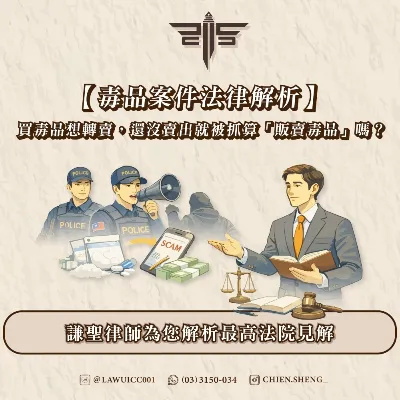 買毒品想轉賣但還沒賣出被抓,算販賣毒品嗎?販賣毒品未遂與意圖販賣而持有的法律差別買毒品想轉賣但還沒賣出就被抓,是否成立販賣毒品?本文解析販賣毒品未遂與意圖販賣而持有的法律差異。毒品案件知識文 2026.06.03
 Stopped or Arrested by Police in Taiwan? Police Stop, Search, Vehicle Inspection and Legal Rights ExplainedCan police in Taiwan stop you without a reason, search your car because of a prior criminal record, or open your bag without a warrant? Learn the legal limits of police stops and searches, what to do if you are arrested, and how to protect your rights during police questioning.毒品案件知識文 2026.08.24
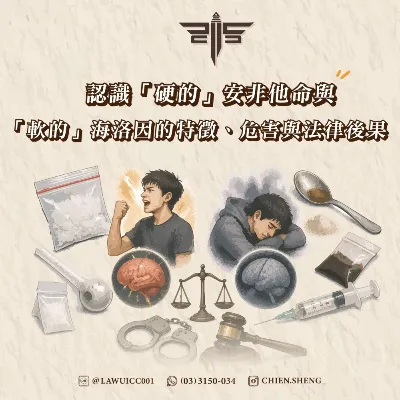 安非他命、海洛因差在哪?外觀、施用反應、毒品分級、刑責與戒癮治療完整解析俗稱「硬的」安非他命與「軟的」海洛因到底差在哪?從外觀、施用反應到健康危害一次看懂,並完整解析第二級毒品甲基安非他命、第一級毒品海洛因的施用、持有、販賣刑責,以及被抓到吸毒後能否爭取戒癮治療。毒品案件知識文 2026.09.03
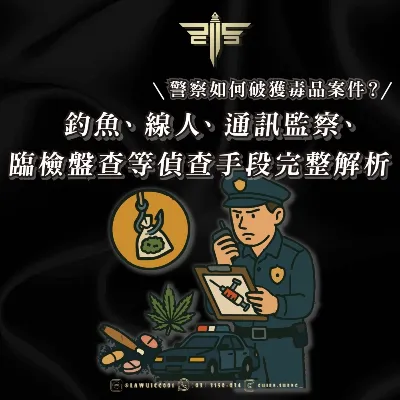 毒品案警方怎麼查?從線人、監聽到搜索驗尿一次看懂警方偵辦毒品案件,常透過誘捕偵查、線人、監聽、臨檢、搜索及驗尿蒐證。本文一次整理各項偵查手段的合法門檻、常見程序爭議,以及涉案當事人可以主張的權利。毒品案件知識文 2026.08.03