1. What Constitutes Drugged Driving Under Taiwan Law?
Drugged driving in Taiwan is governed primarily by Article 185-3 of the Criminal Code, which addresses driving a motor-powered vehicle under legally defined unsafe-driving conditions. The law distinguishes between cases involving specified drug concentration thresholds and cases where other evidence establishes that drug use impaired the person's ability to drive safely.
1.1 Criminal Code Article 185-3 and Drug Concentration Thresholds
Drugged driving may be established when a driver's urine or blood contains a specified drug, controlled substance, similar substance, or metabolite at or above the concentration threshold officially announced under the applicable law. When the relevant statutory threshold is satisfied, prosecutors may not need separate evidence that the driver was visibly swerving, losing control, or otherwise displaying obvious impairment.
However, criminal liability may also arise where the specified concentration threshold is not reached but other evidence establishes that drug use affected the person's ability to operate the vehicle safely.
Relevant evidence may include:
- abnormal driving behavior
- delayed reactions
- impaired coordination
- speech difficulties
- accident circumstances
- surveillance footage
- police observations
➠The legal analysis must consider the substance involved, the applicable concentration standard, and the evidence concerning the person's actual driving condition.
1.2 Why Actual Driving Must Be Proven
A central requirement of Article 185-3 is that the accused person actually drove a motor-powered vehicle.
A positive drug test, possession of vehicle keys, or presence in the driver's seat does not automatically establish that driving occurred. For example, someone found sleeping inside a parked car may have used drugs without necessarily having driven the vehicle afterward. However, the prosecution may rely on circumstantial evidence to establish earlier driving, even if police did not directly observe the vehicle moving.
⚠️The distinction between drug use and actual driving is therefore essential when evaluating whether the statutory elements of drugged driving are satisfied.
2. What Are the Criminal Penalties for Drugged Driving?
Drugged driving is a criminal offense against public safety rather than merely a traffic violation. The applicable penalties depend on the offense circumstances, including whether an accident occurred, whether another person was injured or killed, and whether statutory repeat-offense provisions apply.
2.1 Standard Penalties and Aggravated Offenses
Under Article 185-3, Paragraph 1 of Taiwan's Criminal Code, ordinary drugged driving may be punished by imprisonment for up to three years and a possible fine of up to NT$300,000. Where drugged driving causes serious bodily injury, the penalty may increase to imprisonment for one to seven years. If the offense causes death, the penalty may increase to imprisonment for three to ten years. Additional enhanced penalties may apply to qualifying repeat offenses within the statutory period.
➠A case involving bodily injury or death therefore requires a different legal assessment from one involving a positive test without an accident.
2.2 Does a First-Time Offender Have to Go to Prison?
A first-time drugged driving offense does not automatically result in imprisonment, but the absence of a prior criminal record does not guarantee a favorable outcome. The court or prosecutor may consider the substance detected, concentration level, driving circumstances, whether an accident occurred, the severity of any resulting harm, and the defendant's prior record. The presence of separate drug use or possession allegations may also affect the overall legal strategy.
Depending on the evidence and procedural stage, a defendant may seek non-prosecution, deferred prosecution, a suspended sentence, or another legally available outcome. However, each disposition has different requirements and consequences.
3. Does a Positive Urine Test Automatically Establish Drugged Driving?
No. A positive urine or blood test is important evidence, but it must be evaluated together with the applicable legal standards and evidence of actual driving. The result may indicate the presence of a substance or metabolite without independently establishing when the person drove or whether every statutory element has been satisfied.
3.1 Preliminary Screening Versus Laboratory Confirmation
Police may use preliminary drug screening during an investigation, but an initial screening result should be distinguished from a formal laboratory confirmation test. A preliminary result may justify further investigation, while the evidentiary assessment should examine the formal laboratory findings.
Important information includes:
- the substance detected
- reported concentration
- testing method
- specimen identification
- relevant legal threshold
⚠️A positive result should not be evaluated solely through a verbal statement or an incomplete description of the test.The formal report and supporting records may be central to determining whether the evidence satisfies Article 185-3.
3.2 Testing Procedures, Drug Metabolites, and Evidence Reliability
Drug testing evidence may raise questions about specimen collection, identification, handling, storage, and laboratory analysis. The timing of specimen collection can also be relevant, particularly where the alleged driving occurred before the test. Different substances and metabolites may be subject to different legal concentration standards.
For example, substances associated with so-called zombie vapes, including etomidate, require examination of the actual laboratory findings and the legal standards applicable to the substance and conduct. A product's appearance, informal name, or another person's description does not independently establish the drugged driving offense.
💡Defense counsel may examine whether the testing process was lawful and whether the laboratory evidence reliably supports the prosecution's allegations.
4. Can You Obtain Non-Prosecution If You Did Not Actually Drive?
➥Potentially, yes.
Where the prosecution cannot establish that the accused actually drove a motor-powered vehicle, an essential element of Article 185-3 may be missing. However, the outcome depends on the complete evidence rather than the defendant's statement alone.
4.1 Parked Vehicles and Insufficient Driving Evidence
Being found inside a stationary vehicle does not automatically establish drugged driving. For example, a person may be resting in the driver's seat, waiting for transportation, or remaining inside a parked car without having driven after drug use. Nevertheless, investigators may review surveillance footage, dashcam recordings, vehicle location, engine status, witness statements, parking records, and previous communications. Such evidence may establish that the person drove before police arrived.
➠Where the evidence does not sufficiently prove actual driving, the defense may argue that the statutory elements of drugged driving have not been established.
4.2 Successful Non-Prosecution Case Handled by Chien Sheng International Law Firm
Attorney Wang Sheng-Chieh of Chien Sheng International Law Firm previously handled a drugged driving investigation involving a client who tested positive for drugs.
The central dispute was whether the available evidence established that the client had actually operated and driven the vehicle after using the substance. The defense reviewed police records, scene footage, vehicle conditions, and the relevant timeline. After examining the evidence and presenting the defense position, the case resulted in non-prosecution for the drugged driving allegation.
This outcome demonstrates why proof of actual driving can be decisive in a drugged driving investigation. However, the result was based on the specific facts and evidence of that case. A positive drug test combined with presence inside a parked vehicle does not automatically guarantee non-prosecution in other cases.
5. What Should You Do During a Drugged Driving Investigation?
A drugged driving investigation may begin with a roadside stop, police questioning, specimen collection, or a summons from the prosecutor. The first step is to determine which alleged offense is under investigation. Drugged driving, drug use, and drug possession involve different legal elements and should be analyzed separately.
5.1 Police Questioning and Procedural Rights
When questioned as a criminal suspect, a person has procedural rights under Taiwan's criminal procedure rules, including the right to remain silent and the right to legal assistance. If police request a urine, blood, or other specimen, the legal basis and collection procedure should be examined. The timing of the request, relevant documentation, and specimen handling may become important evidentiary issues.
Individuals should not use violence, attempt to flee, or interfere unlawfully with police procedures. At the same time, they should avoid guessing about facts they do not remember or making inaccurate admissions under pressure. Before signing a police interview record, the person should carefully review whether the statements accurately reflect what was said.
5.2 Preserving Evidence and Reconstructing the Timeline
The timeline is often one of the most important issues in a drugged driving case.
Relevant questions may include:
- when the substance was used
- when the person last drove
- who operated the vehicle
- when the vehicle stopped
- where it traveled
Evidence such as dashcam footage, parking records, surveillance recordings, ride-hailing receipts, mobile phone communications, and witness statements may help clarify the sequence of events.
💡If the defendant was not driving after using the substance, evidence supporting that position should be preserved promptly. All evidence must be obtained and preserved lawfully. Records should never be deleted, altered, or fabricated.
6. Can Drugged Driving Result in Deferred Prosecution or a Suspended Sentence?
Yes, depending on the offense, the defendant's circumstances, and the applicable statutory requirements. Deferred prosecution and suspended sentences are different legal outcomes that occur at different stages of criminal proceedings.
6.1 Deferred Prosecution During Investigation
Deferred prosecution is a disposition made by a prosecutor during the investigation stage.
Under Article 253-1 of Taiwan's Code of Criminal Procedure, prosecutors may grant deferred prosecution for qualifying offenses when the statutory requirements are satisfied. Because ordinary drugged driving under Article 185-3, Paragraph 1 carries a maximum sentence of three years, deferred prosecution may be legally available in appropriate cases.
However, first-time offender status alone does not guarantee deferred prosecution. Prosecutors may consider whether an accident occurred, whether anyone was harmed, the substance and concentration involved, the driving circumstances, the defendant's prior record, and the risk of reoffending. Deferred prosecution may also involve conditions such as payment, community service, legal education, addiction treatment, or psychological counseling, depending on the applicable law and prosecutorial disposition.
6.2 Suspended Sentences After Conviction
A suspended sentence is granted by a court after a conviction, rather than by a prosecutor during an investigation.
Under Article 74 of Taiwan's Criminal Code, a court may suspend execution of a qualifying sentence of imprisonment for no more than two years when the applicable statutory requirements are satisfied. The court may consider the defendant's criminal history, offense circumstances, post-offense conduct, compensation, treatment, and risk of reoffending.
For example, a defendant who has taken responsibility, completed appropriate treatment, compensated victims where applicable, and demonstrated a low risk of repeated offending may present circumstances relevant to sentencing.
⚠️However, where drugged driving causes serious bodily injury or death, the heavier statutory penalties can substantially limit the availability of favorable dispositions.
7. Can Drugged Driving Cases End Without Imprisonment?
Not every drugged driving investigation ends with imprisonment, but the possible outcomes must be distinguished carefully.
Non-prosecution may be appropriate where the prosecution cannot establish the required elements of the offense or where the evidence is insufficient. Deferred prosecution may be available during the investigation stage if the statutory requirements are satisfied and the prosecutor considers the disposition appropriate.
After conviction, a court may grant a suspended sentence where the relevant sentencing and criminal-record requirements are met. Depending on the final sentence and applicable enforcement rules, certain cases may also qualify for conversion of imprisonment into a fine or community service. These outcomes are not interchangeable. Non-prosecution does not have the same legal meaning as deferred prosecution, and a suspended sentence is not the same as an acquittal.
➠The appropriate strategy should therefore begin with the evidence: whether actual driving can be proven, whether the test results are reliable, whether additional narcotics offenses are involved, and which procedural stage the case has reached.
8. Frequently Asked Questions (FAQ)
Q1. Does a positive urine test automatically mean drugged driving in Taiwan?
No. A positive urine test does not automatically establish every element of drugged driving. The prosecution must examine the applicable legal concentration standards, laboratory evidence, and whether the accused actually drove a motor-powered vehicle.
Q2. Can I be charged with drugged driving if I was only sitting in a parked car?
Being inside a parked vehicle does not automatically establish drugged driving. However, prosecutors may rely on surveillance footage, witnesses, dashcam recordings, or other evidence to establish that the person drove earlier.
Q3. What is the punishment for drugged driving under Article 185-3?
Ordinary drugged driving under Article 185-3, Paragraph 1 may result in imprisonment for up to three years and a possible fine of up to NT$300,000. More severe penalties may apply where the offense causes serious injury or death.
Q4. Can a first-time drugged driving offender avoid prison?
Possibly. Depending on the evidence and circumstances, non-prosecution, deferred prosecution, a suspended sentence, or other legally available dispositions may apply. A clean criminal record does not automatically guarantee any particular outcome.
Q5. Can I obtain non-prosecution if police cannot prove that I drove?
Potentially, yes. Actual driving is a required element of Article 185-3. If the evidence is insufficient to establish that element, non-prosecution may be an appropriate outcome.
Q6. Is a preliminary drug screening result enough for a criminal conviction?
A preliminary screening result should be distinguished from formal laboratory confirmation. Criminal liability must be assessed using legally admissible evidence, applicable concentration standards, and the complete circumstances of the case.
Q7. Can drugged driving result in deferred prosecution in Taiwan?
Yes. Deferred prosecution may be available for qualifying ordinary drugged driving cases under Article 253-1 of the Code of Criminal Procedure, depending on the statutory requirements and prosecutorial assessment.
Q8. What is the difference between deferred prosecution and a suspended sentence?
Deferred prosecution is a prosecutor's disposition during the investigation stage. A suspended sentence is granted by a court after a conviction when the applicable statutory requirements are met.
Q9. Can prescription medication lead to drugged driving charges?
Potentially. Lawfully prescribed medication does not automatically constitute illegal narcotic use, but driving while medication significantly impairs safe operation may still create criminal liability under the applicable legal requirements.
Q10. Can a lawyer help challenge drugged driving charges involving etomidate or zombie vapes?
Yes. A lawyer may examine the substance identified in laboratory testing, applicable legal thresholds, specimen collection procedures, proof of actual driving, and whether separate narcotics offenses are involved.
10. Conclusion
A positive drug test after a traffic stop does not automatically establish criminal liability for drugged driving in Taiwan.
Under Article 185-3 of the Criminal Code, the prosecution must establish the applicable statutory requirements, including actual driving and the relevant drug-related evidence.
Urine and blood test results, concentration thresholds, specimen collection procedures, surveillance footage, and the timeline of events may all be decisive.
Where actual driving cannot be proven, non-prosecution may be possible. In other cases, deferred prosecution, a suspended sentence, or another legally available disposition may be considered depending on the offense and procedural stage.
However, drugged driving involving serious injury, death, repeat offenses, or additional narcotics allegations can result in substantially more serious legal consequences.
🧑🏻⚖️Chien Sheng International Law Firm assists clients with drugged driving investigations, public safety offenses, narcotics cases, and related criminal defense proceedings in Taiwan. Early legal assistance may help clarify the evidence, protect procedural rights, and identify an appropriate defense strategy.
【CHIEN SHENG LAW FIRM】
- LINE Online Legal Consultation::@lawuicc001(Click to Consult)
- Appointment by Phone::(03)⠀3150-034
- Payment Methods: Cash|Credit Card|Bank Transfer
【Learn More】

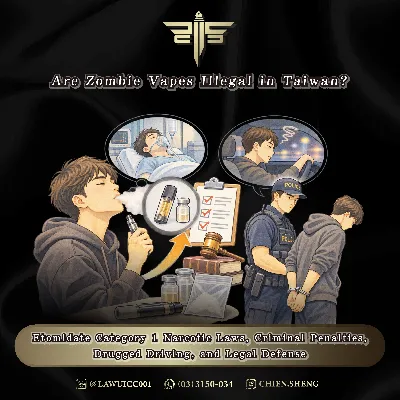 Are Zombie Vapes Illegal in Taiwan? Etomidate Category 1 Narcotic Laws, Criminal Penalties, Drugged Driving, and Legal DefenseZombie vapes containing etomidate are subject to serious narcotics laws in Taiwan. Since June 27, 2026, etomidate has been classified as a Category 1 narcotic, exposing certain offenses to severe criminal penalties. This guide explains the laws governing possession, use, transfer, trafficking, unknowingly using etomidate, drugged driving, and vehicle confiscation, along with important defense considerations under Taiwan's Narcotics Hazard Prevention Act.毒品案件知識文 2026.11.04
 台北、桃園、高雄毒品案件律師推薦|被起訴毒品罪怎麼辦?販賣、運輸、製造、持有、施用毒品如何爭取無罪或有利結果被控毒品案件不代表人生結束。從販賣、運輸到施用毒品,解析無罪、不起訴、緩刑與戒癮治療的辯護關鍵。毒品案件知識文 2026.06.05
 唾液快篩陽性但沒驗尿會怎樣?毒駕與施用毒品解析唾液毒品快篩陽性,但警局沒有驗尿,不代表一定沒事,也不代表必然成立毒駕。本文完整解析行政罰單、公共危險罪、施用毒品及快篩程序爭議。毒品案件知識文 2026.08.07
 警察要求驗尿一定要配合嗎?毒品案件違法採尿、10日撤銷與證據排除全解析警察要求驗尿,不代表只能直接配合。本文整理強制採尿的法定要件、現場如何聲明異議、哪些情況可在10日內聲請撤銷,以及尿液陽性後如何主張違法取證與證據排除。毒品案件知識文 2026.08.05